
Chartering freight vessel will “boost resilience” for island, say SSEN
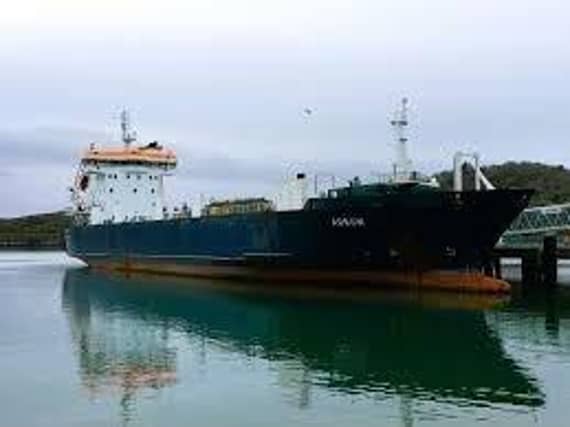

SSEN Transmission are planning to bring in a vessel well-known in the Western Isles – MV Arrow – to support construction of the Minch interconnector.
The company say that “securing a dedicated vessel to handle construction materials and project freight means logistics can be managed independently, without disrupting existing public ferry operations”
They say that “a release mechanism” will allow the ‘Arrow’ to be used by others when not required by SSEN Transmission, “boosting resilience across the islands’ essential ferry network, including during routine maintenance periods.”
The charter, in the name of main contractor Balfour Beatty, follows collaboration with Stornoway Port, Comhairle nan Eilean Siar and Ullapool Harbour Trust, with support from Transport Scotland, CMAL, and CalMac to identify freight solutions.
The initiative comes at a time SSEN Transmission insist they will continue with “business as usual” despite a major planning set-back when Highland Council turned down their application for a sub-station at Fanellan, near Beauly, on which the whole Western Isles interconnector depends (see below for story and editorial).
SSEN Transmission and its supply chain partners are also working with Loganair on travel arrangements for non-island based staff, with most travelling by air. Existing services will be used where capacity is available and charter flights will be considered to maintain capacity for the local community.
The company say that “protecting essential island services has been central to planning for the Lewis Hub, and regular co-ordination meetings are taking place to protect services throughout project delivery.
Sandy Mactaggart, director of offshore delivery at SSEN Transmission, said: “Securing the MV Arrow gives us the confidence and operational capacity to deliver the Lewis Hub project without placing additional pressure on the ferry services island communities depend on.
“It forms a key part of our integrated logistics approach, providing the certainty and flexibility needed to move people and materials efficiently while safeguarding local transport networks.
“Crucially, the MV Arrow will be available to others when not required for our work, helping to protect the resilience of island ferry services. We will also continue to work with other parties to understand their requirements and consider these within our plans.
Scottish Government transport secretary, Fiona Hyslop, said: “This approach has been developed in close partnership with local organisations and stakeholders, including CalMac and CMAL, with a focus on minimising impact on the Stornoway to Ullapool route and ensuring that our lifeline ferry services remain resilient for those who rely on them”.
George Young, director of operations at Balfour Beatty, added: “By working closely with SSEN Transmission and local partners, we’ve taken a coordinated, long-term approach to logistics that protects essential island services while providing flexibility and certainty needed to deliver this nationally significant project.”
It is widely expected the Scottish Government will overrule Highland Council as soon as it is politically possible. However, SSET will first have to come up with amended plans to be approved.
While relief about the transport impact will be welcomed, this latest initiative gives further indication of the sheer scale of what may be about to hit the island.
Beauly refusal could delay inter-connector
A claim by SSEN Transmission that they can carry on with work connected to the Minch interconnector despite a key planning set-back has been challenged by opponents of the development.
The stand-off follows the unanimous rejection by Highland Council’s planning committee of the sub-station at Fanellan, near Beauly, which is crucial to all the windfarm developments on and around Lewis.
In the wake of that decision, SSEN Transmission’s community liaison officer, Kevin Morrison, has issued an update which said “preparatory activities” for the interconnector will continue “ahead of the planned commencement of main works, currently scheduled for summer 2026”.
Mr Morrison’s statement confirmed that SSEN Transmission ”intend to appeal the (Fanellan) decision to the Scottish Government’s Department for Planning and Environmental Appeals” and added that “SSEN Transmission has a legal obligation to deliver these projects”.
He claimed that work could also continue on the cable link between the landing point for the Minch interconnector in Dundonnell, Wester Ross, and Fanellan as “under Permitted Development rights, all necessary consents, permits and statutory obligations (are) in place for these works to progress”.
However, these contentions have now been challenged by Communities B4 Power Companies, the increasingly well-organised umbrella group, behind the successful lobbying campaign to block planning consent by Highland Council for the Fanellan development -= against the advice of its own planning officials.
In a letter to Mr Morrison, the group’s co-ordinator, Lyndsey Ward, wrote: “As of today, no appeal has been lodged, and therefore no planning consent is in force. The refusal remains the lawful planning position unless and until an appeal is submitted and subsequently upheld. For the avoidance of doubt, the lodging of an appeal does not reinstate planning permission or confer any development rights”.
While it is widely expected that the Scottish Government will overturn Highland Council’s decision, this is unlikely to happen in advance of the Holyrood elections in May. Even then, it is likely that the company will need to make significant alterations to its rejected proposals.
This throws into doubt SSEN Transmission’s commitment to start the major works on Lewis by the summer.
In her letter, Ms Ward writes: “In the absence of a consented mainland connection point, the Western Isles HVDC Link does not currently have a lawful or operational endpoint. This is a material consideration when assessing the basis on which enabling works are being advanced”.
Ms Ward’s letter continues: “It is also important to note that the Western Isles HVDC project includes above-ground elements between Lewis and Fanellan, including buildings and associated surface infrastructure.”
With the Fanellan decision by Highland councillors having given campaigners a taste of success, it seems clear that every aspect of the proposed interconnector developments is now set to be challenged and, at very least, delayed, casting further doubt on the eventual outcome.
Gazette comment: An awful way to run an energy revolution
There is something troubling about the interconnector saga. On one hand, the activity rate from SSET indicates rapid progress; including the welcome ferry announcement.
On the other, there is the tricky point that none of the projects on which the interconnector depends has ducks in a row to proceed – planning consents, Contract for Difference or even certainty of interconnection.
Refusal of planning consent by Highland Council for a crucial sub-station near Beauly highlights this dichotomy. Unless it is a “given”, that the Scottish Government will overrule this decision, vast sums are being spent in vain and communities are enduring upheaval for no good cause.
Accordingly, the working assumption (clearly on the part of SSET) is that ministers will disregard any barriers which councils or communities place in the way of these developments. This is not how democracy should work.
It adds up to a dog’s breakfast of uncertainty. We recently saw one ScotWind project, West of Orkney, suspended due to a corporate decision in Australia. The more delays, costs and uncertainties, the greater likelihood of others following.
The ScotWind licences should not have been sold off (cheap) prior to certainty over infrastructure to support them. Community consent and benefit should have been part of that process. We are now left to make the best of a botched job – the worst possible way to run an energy revolution.