
Community barriers in race to join Hebridean windrush

The Hebridean Wind Rush is gathering momentum. But as global corporations secure space on the interconnector planned for development between Stornoway and Ullapool, community energy companies on Lewis are being pushed aside.
On 12th January 2007, Galson Estate passed into community ownership, managed by Urras Oighreachd Ghabhsainn which now receives income from three Enercon 900kW wind turbines connected to the grid through the existing interconnector between Harris and Skye. The first of these was installed in 2013 and the latter two in 2015.
These three turbines generate, on average, 8,871 MWhs per annum (in total) and crucially, over ten years, have supplied an income to the estate that supports up to 18 employees, has contributed £600,000 to community organisations and provides a cohesive, physical foundation upon which the future needs of the community can be built.
Urras Oighreachd Ghabshainn is by no means the only community owned example of renewable energy generation in the Outer Hebrides. Point and Sandwick Trust have three 3MW wind turbines, Tolsta Community Development and Horshader Community Development each have one 900kW turbine, Uist Wind has two 900kW turbines, Storas Uibhist has three 2.3MW turbines and Barra and Vatersay Community has one 900kW turbine.
As these community energy companies have evolved, so too has the financial and well-being investment into the communities they are connected to. It would make sense, therefore, for them to expand, to grow and to reinvest profits into generating more renewable energy.
However, to do this, communities need access to more export capacity. This was requested when SSEN was forced to replace an aged subsea cable from Harris to Skye in 2021. Yet, despite endless discussions and lobbying, SSEN was unwilling to ensure increased capacity for the new cable and a like-for-like cable was subsequently laid – with no prospect of new projects being supported.
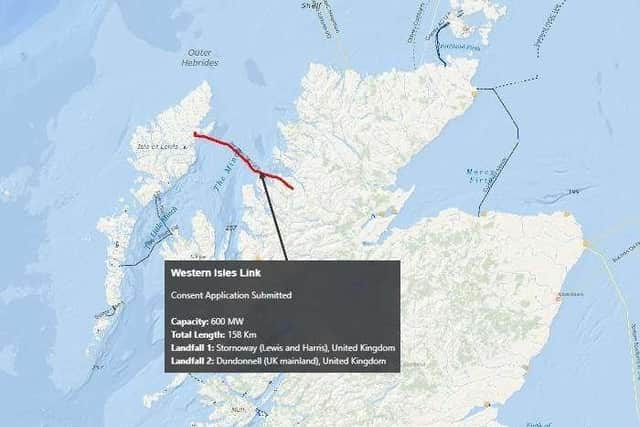
Alongside this, SSEN has been planning for the major interconnector to export electricity to market from planned windfarms. Initially, the scale envisaged was 450 or 600MW but investment from the offshore ScotWind leases have resulted in advanced planning for a 1.8Gw interconnector from Stornoway to Dundonnell.
Accordingly, communities switched their attention to securing space on it for future projects. These include Point and Sandwick Development Trust, Knock and Swordale Community Company and a consortium of three community landowners on the west side of Lewis referred to as West Coast Community Energy – of which UOG is part of. These community owned energy companies have jumped through hoops, completed their paperwork and secured additional space on the new, 1.8Gw interconnector – or so some of them thought.
Over the past six years, Knock and Swordale Community Company have had a mixed experience with SSEN. As Angus Macdonald explained, KSCC have secured planning consent for one 6Mw turbine and by 2020 they were confident that two key aspects of the project – planning permission and grid connection – were aligned and, crucially, secured.
A lease was agreed with the Stornoway Trust and in 2019 a grid connection was offered and accepted (pending completion of the interconnector, then set for 2023). At the time, SSEN were pressing for a 600Mw interconnector and Ofgem was minded to permit a 450MW interconnector. While a decision awaited, the connection date kept getting pushed back.
Then, in 2023, with the huge increase in electricity generation expected from offshore wind farms under ScotWind, Ofgem approved a 1.8Gw interconnector – three times the size SSEN originally discussed. So surely there had to be a place for the community projects?
In the autumn of 2023, however, KSCC were asked by SSEN to re-apply for their previously confirmed 6Mw capacity on the new interconnector to enable SSEN to assess capacity demand – involving not just the amount of time required to re-file paperwork, but also another fee of £12,000. To keep the project on track, the process was completed, and once again KSCC received a firm offer from SSEN for the same capacity on the new interconnector.
In March 2024, in a meeting with SSEN, KSCC were informed that only Active Network Management (ANM) grid access would be available for new community energy projects – a crucial distinction. But KSCC’s project wasn’t new and had twice been made a firm connection offer.
However, a minute of the meeting documented that KSCC were informed that their connection would now be an ANM one. This was not accepted by KSCC and was challenged in writing as a misrepresentation of what had been discussed.
An ANM connection means that a company can only generate power when the capacity is not taken up by the large-scale commercial developments, thus reducing the economic viability of projects and the ability to secure finance for them. Despite assurances from SSEN that they will revisit the connection status; clarification is still awaited.
KSCC have been told they will join the interconnector in October 2033, 19 years after they started to plan their community energy project. No reason has been given for the further delay of three years from the expected interconnector energisation in 2030. Neither has any clarification been given about why SSEN now want to change a firm grid connection, which was offered and paid for twice, to an ANM connection.
In the meantime, KSCC has taken part in what is known as the ‘Gate 2’ process, to winnow out projects that are ready to proceed, such as their own, from mere speculative proposals in order to assess grid capacity requirements.
The issue of an ANM connection is by no means a problem KSCC are navigating alone. Earlier this month an email was sent from SSEN to West Coast Community Energy giving them under 24 hours to accept an alternative offer for standby space on the new interconnector. Failure to accept would have meant restarting the grid application process.
They had previously been advised that capacity was available for their project. This means many things, but crucially for WCCE, they will struggle to secure the £70 million required to fund their proposed community energy project of 43Mw.
WCCE directors have reluctantly accepted this offer, on the understanding and hope that this irregular ‘queuing system’ for the interconnector capacity, coordinated by the National Energy System Operator (NESO) will be re-evaluated in the new year under the aforementioned ‘Gate 2’ process.
As Neil Mackinnon, development manager for the project, commented: “Grid connections are typically the single most challenging aspect of any community energy project. The announcement of a new 1.8Gw interconnector in late 2022 gave fresh impetus to the West Coast Community Energy project and that appeared to be the missing piece of the puzzle for the three community partners.
“However, the reality is turning out to be very different. Incredibly, demand has now outstripped the capacity available even though the interconnector is still five years away. Although the initial set of grid offers received suggested that West Coast Community Energy had achieved one of its main goals for the project, it is clear that the opportunity has passed by for now.
“There is still some hope that capacity could be freed up in the years ahead if other projects are reduced in scale or don’t proceed and the partners intend to continue with key tasks such as a planning application next year.”
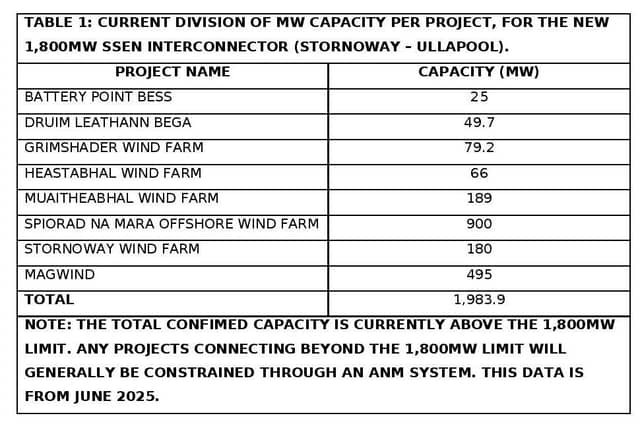
The current Interconnector capacity division is representative of the focus of this report. Of the projects listed none are community owned windfarms (although there is one community owned battery project that has secured 25MW.
Of the eight project,s only four have secured planning permission. In comparison, KSCC have secured consent but have had their agreed allocation of space removed. Understandably, questions are being asked – not only why has this happened, but why has this been permitted to happen and what will be done to alter it?
WCCE may have reluctantly accepted the current qualified offer but have been vocal about the unjust system of allocation. In early August they raised the issue with Torcuil Crichton MP. He, in turn, raised the issue in the House of Commons with Ed Miliband, Secretary of State for Energy Security and Net Zero, who commented: “Let me take away the point he raises about this accessquestion…we are committed to driving forward community energy and we will talk to NESO and Ofgem to get it right and make sure it happens”.
At a recent Scottish Labour community discussion, representatives from both UOG and KSCC voiced their frustrations to a group of political representatives, inclusive of Anas Sarwar MSP. All agreed that more support and clarity are required for community energy, with Anas Sarwar raising the point that what we mean by community ownership needs to be revisited.
He said: “The terms used are too loose. There needs to be a genuine conversation about how we deliver community ownership within this transformative sector and to do this there are two structural areas that need to be addressed – access to the National Grid and the Scottish planning system which is completely defunct and not fit for purpose”.
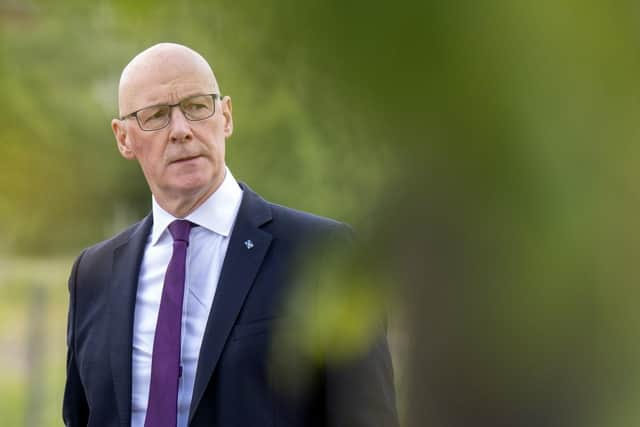
Subsequently, the issue was also raised with John Swinney, the First Minister, who made it clear that when he had recently been in talks with NESO, alongside Gillian Martin (Cabinet Secretary for Climate Action and Energy), they were assured that this type of situation would not occur. He confirmed that he would take away what had been raised and look into it.
Positive support from political representatives is, of course, encouraging, but how that support will influence the ‘Queue’ system, redress the imbalance of power in allocation of space on the new interconnector, and ultimately the potential for the continued success for models of community owned energy companies is yet to be seen.
What is clear though is that, whilst community owned estates like Galson ride out the wait and pivot and push and plan to safeguard the future of the communities they are invested in, they will not stop moving forward. Plans are afoot for considerable investment in new housing projects within the estate, and it is possible that SSEN may be one of the key investors in one of these projects.
Although this potential investment would be to facilitate accommodation for some of the estimated 1500 workforce required during the construction phase of the interconnector project, the housing development would remain in the ownership of UOG and thus community.
So, a community owned estate that generates a sustainable income through community energy has reached the stage of being able to identify the need and plan for affordable rural housing for the community. And yet, potentially, to facilitate the initial stages of this development, investment may be provided by the very entity that is also influencing, negatively, the growth of community energy associated with the same community owned estate!
The complexity of this riddle is indicative of one thing – the only certainty when it comes to the impending ‘Hebridean Wind Rush’ is that it is complicated and so very, very important to understand.
(We are very grateful to Netty Sopata for permission to re-produce this article which was written for the Fios community newsletter. It was produced in partnership with the investigative journalism project, “The Scottish Beacon – The Power Shift”, with thanks to Neil Mackinnon (UOG) and Angus MacDonald (KSCC).