
Ferries, housing and the Ness guga hunt
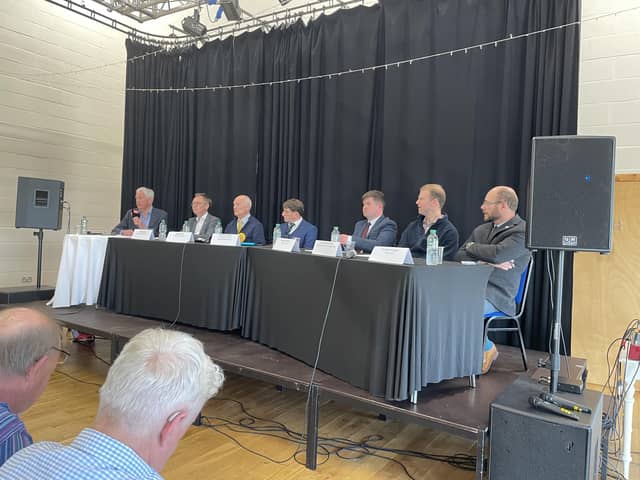

Depopulation is the single biggest political challenge facing the islands, with several other crucial factors – such as housing and ferries, or more pertinently the lack thereof – all contributing to the crippling loss of a working age population within the community.
So was the consensus among the six candidates standing for the Scottish Parliament election on 7th May when they took to the stage at a hustings organised by the local community newsletter in north Lewis, ‘Fios’, and held at the Clan Macquarrie community hall last Friday. The difference, of course, was in how to address it, and who had the best solutions.
The format of the evening, chaired by David Green of Ness Community Council, saw questions being pre-submitted by email, along with further questions from the audience on the night.
The six candidates were: Alasdair Allan, SNP; Jamie Dobson, Liberal Democrats; Kenneth Mackenzie, Alliance to Liberate Scotland and Sovereignty; Donald Mackinnon, Labour; George Macpherson, Scottish Conservatives; and Malcolm Mactaggart, Reform UK.
The opening salvo on depopulation quickly, and naturally enough, dovetailed onto the lasting and continuing damage caused to the islands’ economy and reputation by a failing ferry service.
Recognising the uncomfortable situation of having to represent a government which for nearly 20 years has had responsibility for a decaying islands ferry service, Mr Allan said: “I can tell you I’m not going around doorsteps attempting to justify the situation in relation to ferries and believe me that was certainly true when I was in Uist and Barra – and true, here, too.
“I would say, however, that anyone who claims to have a solution other than building ships is trying to have you on.”
Mr Allan said that “housing is the biggest issue people have come to me with in terms of frustration in not being able to live here”. The answer, he said, was for an extension in social housing provision, which his party has promised. “Nothing wrong with building in Stornoway, but we need to be building in other parts of the islands.”
Depopulation “goes to the heart of why I decided to stand for this election”, said Donald Mackinnon. “I’m worried about the future of our islands, I’m worried about the outlook for our population, its size and demographics, and the reasons for that extend to things like availability of housing, good jobs and what I hear is people telling me that services are going backwards.”
But, also importantly, he continued, transport links.
“When I look at these things and I look at the Scottish Parliament, there are powers there that we could be using to do better for our islands and that’s why we need proper representation in the Scottish Parliament.
“On ferries, we would look at over-hauling the governance structure. The current system is not working and not delivering for our islands. We would merge CMAL and CalMac into one agency and make sure islanders are on the board and making the decisions for these islands.”
Reform’s Malcolm Mactaggart said that the “ferries have really focussed things with population decline”, adding: “If we can’t keep a population here and help businesses, we’re going to continue in the same direction.
“The most pressing thing is the ferries and I don’t think it’s a particularly complicated thing. They manage to run them in Norway, Shetland and other islands. The complication of the system is the problem.”
In a similar vein, George Macpherson for the Scottish Conservatives, an educational consultant, said that the islands had much to offer, “but the reliability of transport really matters”.
Kenneth Mackenzie, of the Alliance to Liberate Scotland, warned of an “impending recession” which will exacerbate depopulation and called for a moratorium on windfarms in the islands until a deal could be struck for cheaper bills for islanders. “The benefit should be going to the people here, not people down in England.”
Energy issues featured prominently in the hour and half long debate, in particular the controversial Spiorad na Mara project just off the coast of the west side of Lewis, a subject which dominated the contributions from the floor.
Jamie Dobson said he was “totally against N4”, but that the islands could have a rich energy-based future, particularly in taking advantage of developments in the field of hydrogen.
Chairman David Green asked for a show of hands from the candidates as to who would, if elected, mount a campaign to block the Spiorad na Mara windfarm. Only four did. Alasdair Allan and Donald Mackinnon declined.
All the candidates broadly agreed that more renewable energy was needed, but it had to be balanced with community impact and community benefit.
Alasdair Allan said he was “on record” as calling for a public inquiry into Spiorad na Mara, while Donald Mackinnon said there was a “consenting process underway and it is really important the community engages with that in a way that people didn’t really get the opportunity to engage when the decision was taken to license that area by the Scottish Government.”
Just before the end, there was time for one topic on which there was absolute consensus from all of the candidates – the need to allow the traditional guga hunt by the community of Ness to continue – an entirely unsurprising outcome, and particularly so given the location of the event in north Lewis.
The Clan Macquarrie hustings was recorded by Fios and can be viewed on You Tube