
Fish farm would be “biggest ever loss to fishing industry”
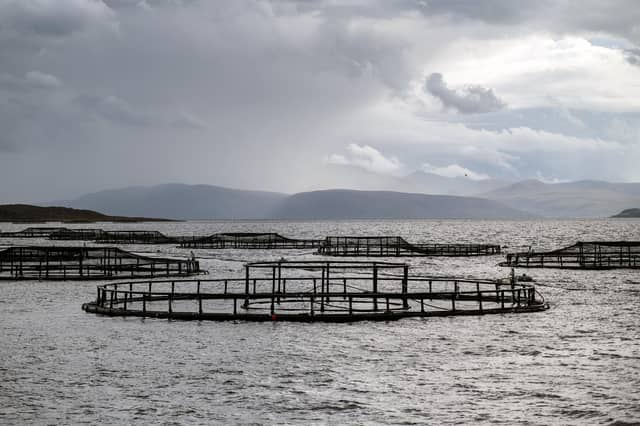

Comhairle nan Eilean Siar planners have recommended approval, subject to conditions, for a fish farm off the east coast of Lewis, amidst warnings from the local fishing industry that it would result in the loss of “prolific” commercial fishing grounds.
The Western Isles Fishermen’s Association (WIFA) has objected to the North Gravir Fish Farm proposal, stating it “would impose the biggest ever loss to the Scottish fishing industry of prolific commercial fishing grounds that have been harvested sustainably for generations.”
A planning report published ahead of next week’s Planning Applications Board meeting recommends permission, subject to conditions, be granted to developer Bakkafrost Scotland Ltd for five large circular pens approximately 60-80 metres from the south Lochs coast.
The development would have a maximum biomass of 4,680 tonnes of Atlantic salmon, covering an area of 1.6 hectares, with the cage edge approximately 300 metres from shore. The nearest settlements are Calbost, just over 1km to the northwest, and Gravir, over 2km to the southwest.
In their objection, WIFA stated that the site “has consistently provided large volumes of prawns, scallops, and brown crab that are all landed locally, creating long-term sustainable employment opportunities both at sea and ashore at the modern MacDuff Shellfish factory that has been built at Goat Island at a cost of £3M.”
WIFA’s objection stated: “The land and the sea are valuable natural assets and maintaining a pristine sea environment should be a unique selling point for the Western Isles, as well as ensuring that maximum economic return and linkage is gained for the community.
“This new site off Gravir is already too close to another site at Loch Odhrain and industry has already provided alternative sites that could be developed with less impact on commercial fisheries.”
WIFA alleged in their objection: “The greed shown to proceed with a large offshore site without considering the negative impact that their operations will have on traditional fishermen clearly demonstrates that this industry seems content to destroy the livelihoods of local fishermen.”
WIFA also raised concerns that the site provides “unique shelter for vessels during periods of strong winds from a south-westerly to northerly direction, coupled with vessels being able to haul their gear safely in this specific area.”
Western Isles District Salmon Fisheries Board (WIDSFB) has raised concerns as a consultee, calling for no planning decision until a Wild Fish Monitoring Strategy is agreed upon.
WIDSFB noted current uncertainties over sea lice regulations and called for a “robust” Environmental Management Plan with ‘stable isotope technology’ at the site. The technology “can identify if high lice burdens on wild fish originate from the fish farms,” WIDSFB has clarified.
Bakkafrost Scotland Ltd have been approached for a response to the objections raised by WIFA and WIDSFB; none had been received at the time of going to press.
Other objections to the development included concerns over the “excessive” scale, damage to the seabed, fish disease and parasites, reduction in biodiversity, impacts on wild fish, and risk of escapes.
Three letters of support from local businesses stated “the positive economic impacts of the development.”
The planning application is an Environmental Impact Assessment (EIA) application, with an EIA submitted by Bakkafrost Scotland Ltd.
The planning report states the EIA assessed “the likely significance of the effect of the proposed development on the wider environment, and has informed the planning assessment.”
The EIA details the development would provide five permanent jobs with estimated direct economic benefits of £606k annually, with a cumulative contribution of over £1 million per year to the wider Scottish economy.
The conclusion of Bakkafrost Scotland Ltd’s EIA states that the proposed development “has been designed in such a way as to ensure that environmental effects have been minimised through a combination of careful siting in an exposed, high-energy location and embedded design and operational mitigation.”
The EIA concludes that the design process “has represented a good practice approach to the reasonable development of marine aquaculture,” and states the proposed development “complies with, and is supported by, the aims and objectives of both national policy and the [Local] Development Plan.”
But the planning report states, “It is difficult for the Planning Authority to counter either stance and therefore considerable weight must be given to the content of the EIA report and associated Appendix,” adding: “It is not contested that there will indeed be a loss of income to commercial fishermen as a result of the proposed development.”
The planning authority acknowledged in its report, “the challenge of addressing competition for the same space in the marine environment between two sectors that lay equal claim on grounds of the environmental impact and economic benefits arising.”
Subject to mitigation measures secured in conditions, the planning report concludes the proposal “would have a largely neutral residual effect” on various environmental and socio-economic factors, and recommended approval for the development.