
Grinneabhat’s brighter future with solar panels
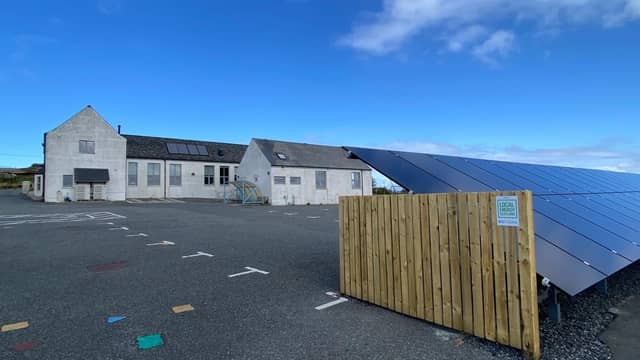

Despite only coming into operation very recently, a Lewis-based community organisation have said that they are already seeing the benefits of having installed an array of solar panels on their public hub.
The Grinneabhat centre is located in the former Bragar Primary School and offers a range of services for the community, including a ceilidh and performance room, on-site accommodation, kitchen and exhibition space.
Following a grant from the Scottish Government’s Community and Renewable Energy Scheme (CARES) Community Buildings Fund, the Trust that runs the facility installed an array of 48 solar panels, including two battery storage units.
The project was designed and installed by O'Mac Construction Ltd, MCS-certified island contractors, who are experienced with renewables for community organisations.
A total of 80 per cent of the funding required came from through the CARES application, with the remainder coming from the Horshader Community Development Trust and the Western Isles Development Trust.
Christine Macleod, Chair of the Board of Trustees for Urras Coimhearsnachd Bhràdhagair agus Àrnoil, who manage Grinneabhat, said: “It is encouraging to see the savings that we have already been able to make, despite the weather.
“We’re grateful to all the funders, and particularly Isla Vandevoorde, development officer from Local Energy Scotland, who supported us throughout the process from initial advice to completion.
“We’re also thankful to O’Mac whose team managed to complete the installation within a tight timeframe and in winter weather. It has been a great example of local resilience and community organisations supporting each other.”
The Trust said that “the new panels and batteries give Grinneabhat greater energy independence at a time when multiple global crises are putting pressure on ordinary people and small organisations alike, and there is an appetite for community-owned energy”.
“As energy costs have risen dramatically in recent years, the project was needed to help ease financial pressures on the organisation,” they added. “Now it is up and running, it will allow the money saved to be allocated to community needs rather than being spent on energy bills.
“With the daylight hours getting longer, Grinneabhat will be protected from more economic shocks in the coming months, and less dependent in the years ahead on volatile energy markets: Good news for the community, and good for the planet, too.”