
“Scandalous” statement on Comhairle funding
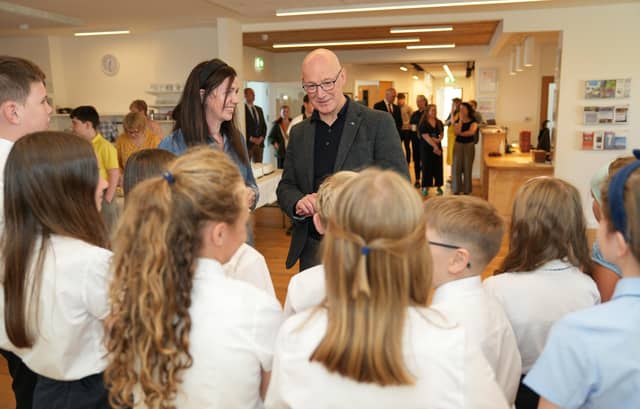

First Minister John Swinney was under fire this week for his claim that Comhairle nan Eilean Siar’s funding settlement which punishes depopulation and falling school rolls is “out of the hands of Ministers”.
Mr Swinney’s assertion, during a visit to Lewis, that the distribution formula is solely a matter for the Convention of Local Authorities is contradicted both by COSLA itself and the Scottish Government’s own public funding manual, which make clear that the formula is determined by negotiation between Ministers and COSLA.
It has angered political opponents, who accused Mr Swinney of being “economical with the truth” and failing to respond to the needs of the islands which have suffered by far the worst fall in revenue allocation of any Scottish local authority over the past decade.
Comhairle nan Eilean Siar said they have “consistently made the case” to the Scottish Government both for increased overall funding for local government and also “a fairer share” for the Western Isles.
The COSLA web-site explicitly states: “Decisions on how funding should be distributed are a joint process. The Scottish Government and Local Government work together to assess the validity and robustness of indicators, the data that sits behind them, and whether proposals developed by the Scottish Government will ensure that the funding goes where it is needed in Scotland”.
Similarly, the Scottish Government Public Funding Manual states: “The total revenue funding available is distributed between Scotland's local authorities using a ‘needs-based’ distribution formula that is kept under constant review and agreed each year with COSLA”.
Labour candidate, Donald Mackinnon, described Mr Swinney’s comments as “scandalous”. He said: “It is absolutely clear that if the political will existed, there could be an adjustment to the funding formula which fails the Western Isles so badly.
“If this had been argued for consistently over the years, we would not be in our current position. I would certainly see that as the first duty of an islands MSP at Holyrood”.
In a statement, Comhairle nan Eilean Siar said: “To deliver services at appropriate levels, continue to address our population issues and encourage sustainable economic growth we must receive appropriate, sustainable levels of funding.
“Alongside wider work on Public Service Reform, the Comhairle has consistently made the case to both Scottish Government and COSLA that the current Local Government funding formula does not and cannot fully meet the needs of the Western Isles.
“The current formula places a heavy focus on population numbers. The static population of the Western Isles and falling school roll, alongside other factors, has contributed to the reduction in the Comhairle’s budget with a fall of 18 per cent (in real terms) over the course of ten years”.
The statement continued: “The flaws in the current system are further evidenced by the Comhairle’s unhealthy dependence on the main funding Floor and the supplementary use of funding through Special Islands Needs Allowance, Island Councils Cost of Living funding and with the use of Crown Estate Revenues.
“Finding a single funding formula that produces positive outcomes and the required levels of funding for all 32 Scottish councils is a challenging task. To achieve parity and fairer funding settlements there must be a greater acknowledgement of area specific challenges and with consideration for this more flexibility in the application of the currently rigid funding formula.
“The delivery of funding is the responsibility of COSLA and Scottish Government and Comhairle nan Eilean Siar will continue to make the case for positive change to both organisations. To continue delivering public services at required levels all Scottish councils need more funding and Comhairle nan Eilean Siar needs a fairer share of that increased funding.”
The fact that Ministers can drive changes to the formula is confirmed by a reference in the Public Funding Manual to the “floor” mechanism which protects any council from falling below 85 per cent of the average figure. This was introduced in 2012 by “Ministerial decision”.
EDITORIAL COMMENT: Mr Swinney can’t wash his hands on funding.
John Swinney probably expected to meander through the Western Isles without controversy, leaving a scattering of money from various funds in his trail and sharing videos of the scenery.
But life is never that simple and Mr Swinney has stirred a hornet’s nest which lies at the heart of the islands’ many challenges – the funding formula which has resulted in a steady reduction in Comhairle nan Eilean Siar’s revenue on which its services depend.
When this was raised with Mr Swinney, he gave a reply which he may or may not have believed to be true – it is difficult to say which would be worse – that, once the total available to Scottish councils is set, it is then solely down to COSLA to determine how it should be divided up.
This is just not true. If Mr Swinney had been persuaded during his visit that there are certain exceptional factors in the Western Isles – as there are – he could have acted as First Minister on returning to Edinburgh and told his officials in no uncertain terms: “Find a way of sorting this”.
The fact his visit coincided with demographic statistics showing huge drops in both under-16s and working age population should have helped persuade him and a small tweak would be required to recognise the special case of the islands.
By trying to wash his hands of responsibility, Mr Swinney has inadvertently served to highlight the reality which he sought to deny.