
Time to revive memories of a Lewis-born philosopher
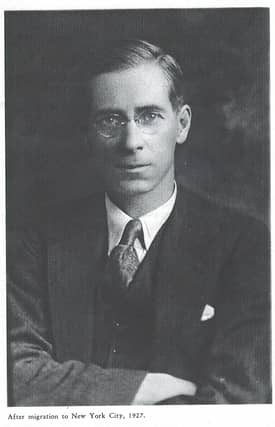

We do a good job on Lewis of remembering and celebrating our bards, our makers – of music of course, but of bread and marag too – but what of our intellectuals, our thinkers?
Outside of theology, is there a single intellectual we could name from even a generation ago? We are missing opportunities of all kinds if we neglect those locals who have shaped thinking throughout the world.
One such shaper of world thought is Robert Morrison MacIver (1882 – 1970), a political philosopher at a time of intensely contested politics and a sociologist at a time when the discipline was defining itself. He’s not entirely forgotten; he has a Wikipedia page, a charming Youtube video in Indonesian, and was included in the Nicolson’s Roll of Honour website until the Comhairle’s data breach took the website down.
But are any of his words remembered on Lewis? Perhaps first we should ask: is anything he wrote still relevant? How about this, from The Ramparts we Guard (1950):
“Power tends to engender assumptions of superiority that only very wise men can hold in check. If not thus checked … power then becomes vain and hard-shelled and anti-democratic.”
The contemporary resonance sounds loudly, convincingly, and urgently, especially from a Lewis voice. Every Western Isles school leaver should be able to quote “vain and hard-shelled and anti-democratic” or another of MacIver’s punchlines, just as they can quote a line or two of Iain Crichton Smith poetry or Disraeli’s acid character assassination of Sir James Matheson.
Or, then again,
“The present refuses to be an enforced and thus unreal copy of the past.”
which encapsulates MacIver’s life-long discomfort with unbending social conservatism.
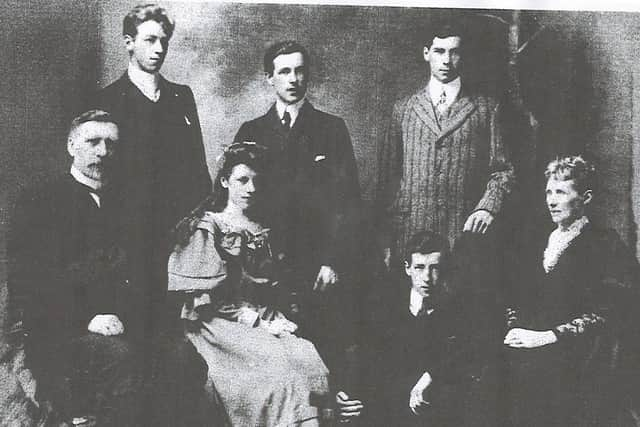
MacIver was born in Stornoway in on 17th April 1882 into the apparently comfortable, perhaps even prosperous, home of Donald and Christina (née Morrison). Robert finished senior school at the Nicolson as Dux (1897) and headed to Edinburgh where he graduated MA (1903), then Oxford for a BA (1907), back to Edinburgh for a DPhil (1915), before taking up his first academic post at the University of Aberdeen, teaching political science.
His most senior academic positions were in Canada and the USA, ending his career as Lieber Professor of Political Philosophy and Sociology at Columbia University, one of the eight Ivy League universities of the United States. He had a long and very distinguished career, with his two most substantial books staying in print for decades and multiple editions.
MacIver was no “ivory tower” academic as his long list of public roles in North America confirms. After retiring in 1950, he spent the next decade serving in a variety of public service positions, including the City of New York Juvenile Delinquency Evaluation Project (1956-1961), He was President of the New School for Social Research, and a director of research for Jewish Defense Agencies, Assault on Academic Freedom and the United Nations. MacIver was a fellow of the American Academy of Arts and Sciences, the American Philosophical Society, and the British Academy.
His most significant contribution to thought was to carefully disentangle society, community and the associations we form amongst ourselves, including the state. This way he was able to set out a detailed and flexible conceptual picture of the kinds of relationships that form between individuals. He sets his concepts out in thoroughly argued detail in Community, a landmark treatise at the intersection of philosophy, political science and sociology first published in 1917 and then repeatedly updated until the year of his death, 1970.
To ‘place’ his philosophy succinctly: he is openly indebted to Plato, trenchantly critical of Hegel and Marx, dismissive of pessimists like Schopenhauer, not keen on Nietzsche, and closest in thinking, to this reader at least, to A. N. Whitehead and to ecologists like Howard Odum.
MacIver’s great ‘law’ of community is that “individuality and sociality are two sides of a single process”. He means that the development of wholly fulfilled individuals cannot be achieved without wholly fulfilling our most meaningful social interactions. This is a never-ending task of social and personal progress; MacIver is nothing if not optimistic!
“Socialising interests increase continually where life itself increases, while the desocialising interests diminish continually.”
He recognises the very frequent backsliding throughout the (mostly western) history he uses to illustrate his theory but is not daunted by it.
His thinking about community gives rise to some starkly clear statements about problems we still face. He is anti-war whilst recognising what social mis-steps lead to it. He strongly supports intergovernmental organisations such as the League of Nations and decries isolationism. He lambasts misogyny; he advocates righting the wrongs of slavery, especially in North America.
In 1950s USA, at the height of McCarthyite paranoia, he declares that he is probably considered a ‘Pinko’. He is a refreshing read still now, even if some of his sentence structure seems archaic, even if he continuously uses the masculine gender when discussing people in general (as was the style of the time), and even if he sometimes uses words from which we would shrink (especially ‘primitive’, ‘barbarian’, ‘stock’, and ‘race’). He reasons well and can be beautifully rhetorical:
“There is no opposition, as Machiavelli thought, …between might and right. Every true cause yokes might to right, every untrue cause yokes might to wrong.
“It is so natural for people to conclude that what they think is wrong should be on that account forbidden… So we move down the darkening road that leads to the prison-house of dogmas and technological terror.”
Plenty of important and engaging philosophy has been written before and since but, with such a strong local connection, surely here in the Western Isles at least his work should be remembered?
Not that MacIver thought fondly of his Stornoway upbringing; it seems that, like many, he railed as a youngster against a social strictness he found oppressive. When he argues that calcified social structures become a barrier to progress, he uses examples from Europe and from the classical world, but you can’t help thinking that turn of the 20th-century Stornoway is in his mind too.
MacIver had no romantic yearning for an idealised Lewis, to his credit, yet he put community at the centre of his sociological theory, argued that the continuance of small communities was essential, titled his autobiography with a line from Psalm 90, and wrote unironically about the role of religion in community and the faith required to sustain democracy. It seems, like Iain Crichton Smith, that MacIver needed to be at some physical remove from Lewis. For Crichton Smith, Oban was far enough; for MacIver it was Toronto and then New York.
As his obituarist noted: “From a young age, MacIver retained a persistent rebellion from the Presbyterian piety of his father. He held a lifelong distrust of orthodoxy, both religious and social” However, we should not use MacIver’s complicated relationship to Lewis as reason to forget him in his birthplace. Much better surely to celebrate an intellect of global stature and to engage critically with his words from our privileged vantage point of a shared place of origin. Let’s bring him back into our conversations, into our citizenship classes, onto our bookshelves.
MacIver’s left-liberal politics are an important counterweight to the politics of the currently most famous person with Lewis connections. His work exemplifies a thread of communitarian and socially progressive thought that can be overshadowed in stereotypical depictions of a Lewisian culture polarised between Calvinism and nihilism. We have a powerful voice of reason in our island heritage who deserves to be remembered, studied and debated.