
How a Calanais pioneer helped uncover its secret history
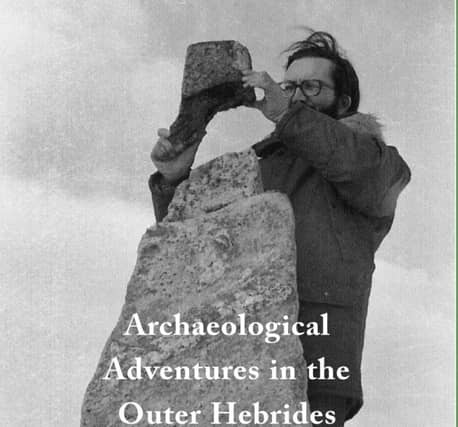

Amateur archaeologist and former Stornoway Gazette columnist Gerald Ponting, famed for his work at the Calanais Stones and co-writer of the first guide book to the site, is coming back to Lewis for the first time in nearly 20 years for his book launch – and formally returning a stone axe to the island after having it in England for nearly 40 years.
Gerald’s book, “Archaeological Adventures in the Outer Hebrides”, is being launched in Stornoway Town Hall at 7pm on Thursday, 4 September, and has been partly based on the articles he wrote for the Gazette during his 10 years in Lewis.
There is a large section devoted to Gerald and first wife Margaret’s research at Calanais, which included the phenomenal discovery of a stone which had lain under the earth for years.
There are memories of other discoveries too, including the Shulishader axe – considered to be one of the finest examples of its kind in Britain – and another stone axe that was found within the walls of a blackhouse in South Lochs and subsequently given to Gerald.
This stone axe, found in a blackhouse in Gravir, will be formally handed back to the people of Lochs during a ceremony in Ravenspoint, taking place on Tuesday ahead of the book launch.
As a work, his book has been described as offering “a vivid and richly illustrated account of one couple’s extraordinary contribution to the understanding of Scotland’s prehistoric past”.
The couple’s work was seen to have not only contributed to academic knowledge but to have also bridged the gap between academia and community. It is an important record of Hebridean heritage but is also a personal memoir.
Published by The Islands Book Trust, it contains 110 photographs and a foreword by Calanais archaeologist Dr Alison Sheridan, who described it as “a cracking read”.
Speaking to the Gazette this week, Gerald shared some of his memories of his time in Lewis and how his new book came about. He began working on it around a year ago.
He explained: “I’ve still got this folder with photocopies of all the articles I wrote for the Gazette all those years ago and at the time I’d hoped it would make a book but it never happened.
“With my ex-wife having passed away, I thought perhaps now was the time to bring forward the stuff that we did together. I’ve had all those Stornoway Gazette articles from the 70s and 80s sitting in a folder for decades.”
They would be key to the book but he also included pieces written for the Hebridean Naturalist and Current Archaeology, as well as further material, and personal experiences.
Looking back to 1974, Gerald said: “We were living in Suffolk. We weren’t involved in archaeology. We were both teachers. We had a motor caravan. We spent five summer holidays in the Hebrides.”
When a job came up at the Nicolson in Stornoway, for a biology teacher, Gerald went for it and bought a house at the Breasclete end of Calanais, just about a mile from the stones.
Having always been interested in their surroundings, and previously written a book on the village where they lived, the couple were shocked to discover there were “no guide books to the place”.
So they started “delving into the archives… getting lots of photocopies sent from Edinburgh” and after about two years decided that since nobody else had written a guidebook, they could.
They were quoted a deal of £450 from a local printers for a thousand copies, “hummed and hawed”, and were then told: “You have got a bestseller on your hand here. I’m not going to ask you to pay for the first thousand till you come back and ask for the second thousand.”
It was an offer they couldn’t refuse. The book was printed in May and they were back for the second printing in the July.
“That was the first ever guidebook to the stones. It sold for 75p and it filled a gap. Not just for tourists but for local people who’d not had the information. We had that in print for seven years. It sold 13,000 copies and that sort of financed the rest of our research.”
The couple “carried on finding more things” but by 1984 the marriage was failing. “Ultimately we split up and I lived in a flat in Stornoway for a year and then came back to the south.”
Margaret remained in Lewis, remarried, and remained active in local archaeology.
Gerald gives Margaret full credit. “All the research between 75 and 84 was joint work we did together. What I’ve done now is go back and resurrect all that work from those 10 years and bring it up to date with new things I’ve learned.”
Looking back, Gerald believed the general feeling at the time was that islanders did not want to look over history too much, because of all the “bad history”, all the “things that had gone wrong in previous centuries including the Clearances”.
But he believed their work sparked an interest in prehistoric archaeology and soon the idea was growing that “Calanais was at least the equal of anything else anywhere in Britain”.
He said: “My Gazette articles, as much as anything, were bringing forward information which had never reached the islands. We felt that we had an opportunity given to few amateurs in that there was a major site only a mile from our home which had never had an in-depth research project.”
They would take their information “to the professionals and lo and behold the professionals came and followed that up…
“The major excavation at Calanais was 1980 to 1981 by Patrick Ashmore and he had all his own reasons for doing that but I genuinely believe it would have happened a few years later if we hadn’t kept nagging him with stuff that we’d discovered.”
What they had discovered was a Calanais stone underground. Because the area of interest was outwith the actual site itself, “we just needed the local crofter’s permission to do some research there and he happened to be our local postman anyway, so we laid out a grid and probed with a metal rod to find how deep it was and proved that the stone was still there underneath.
“And Angus said, ‘oh, I’ll go and get a spade’, and we said, ‘no, you can’t do that’. Again, we sent all this information to Edinburgh and that was 78, I think. So when Patrick Ashmore started his dig, one of the first trenches was where we’d predicted this stone – and there it was.
“I didn’t see it being uncovered sadly because I was a teacher. Margaret was there on site helping as one of the volunteer diggers and they uncovered this stone.”
Seeing it in the flesh was a “wow” moment. “‘There it is! There’s the stone we’ve been talking about and telling people about for the last two or three years’. Better still, a couple of years later, it’s re-erected and you find it standing there now. It’s the furthermost stone on the east row.”
Discoveries beyond Calanais
The story of the discovery of the Shulishader axe is also in the book and Gerald describes this as one of the “accidental finds”, albeit “a huge, huge find”. He learned of it from Sam Maynard.
“Somebody phoned him and said, ‘we’ve found a stone axe; It’s got its handle still. Is this unusual?’ and he said, ‘unusual? It’s unheard of.”
“We went to his croft house. We saw this axe with its handle, all neatly wrapped up to stop it drying out – thanks to my advice in the paper earlier – and I then phoned the National Museum and it was sent out promptly and into conservation labs, and I think it’s probably the best preserved stone axe in Scotland, possibly in Britain.”
Speaking of stone axes, Gerald confirmed he will be repatriating another one back to Lewis at a handover on Tuesday, 2 September, at 11am.
“I’m going to Ravenspoint museum and we’re going to have a little ceremony of me handing over this axe that’s been lingering in the south of England for 40 years and it’s going back to within five miles of where it was originally discovered.”
The story of the axe begins in Cromore, where a man from that village was involved in building a new jetty at Gravir. Wanting new stones for the jetty, they were “demolishing granddad’s blackhouse and in amongst the stones of the blackhouse they found this stone axe”.
The artefact was not subject to the usual rules of Treasure Trove because it was not found in the ground – but rather in a built structure – so Gerald could legitimately keep it.
There were two stories around it. “One was that old people finding these things thought it was good luck to build it into a wall and the other thing is they also found them very useful for cleaning sheepskins.”
Over the years, he has enjoyed taking it to relevant talks as it is “beautifully shaped” and sits nicely in the hand.
“I passed it round, so that people in Hampshire were getting the chance to hold something over 4,000 years old in their hands and it was magic. I felt that it was performing a useful function down here even if it wasn’t back where it should be.”
Gerald said his trip to Lewis would be “the latest adventure” and he was “looking forward to coming back and meeting a lot of people I knew all these years ago”. He was last here in 2006.
He is also hoping to catch the Major Lunar Standstill at Calanais, before its season ends. “It’s a half moon rather than a full moon but the moon will be very low,” said Gerald, before adding: “I’ve been waiting to see that since 1980 but it’s almost sure to be cloudy.”