
The Lewis connection at the heart of a fight for women’s rights
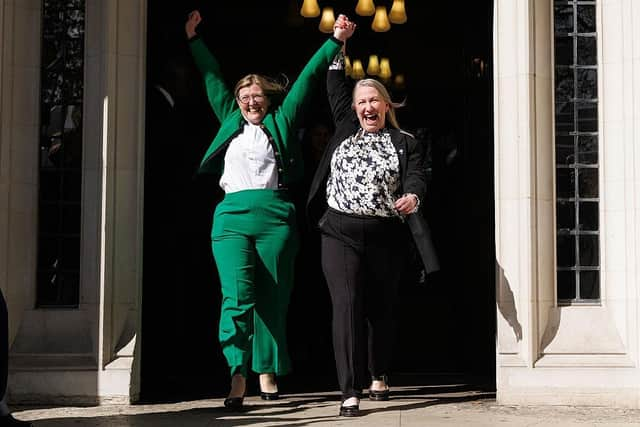
In her wildest dreams, some of them formulated during childhood years in Lower Bayble, Marion Calder would never have expected to be emerging from the Supreme Court in London, celebrating a landmark legal victory in defence of women’s rights.
That was, however, the position Marion found herself in last week as one of the three founding co-directors of For Women Scotland which took the Scottish Government all the way to the Supreme Court, to secure the legal definition of a woman – and won.

Marion is the daughter of a Lewis mother and the grand-daughter of a famous figure in the post-war history of Point – Coinneach “Red” Macleod – shopkeeper, fisherman and published Gaelic poet who wrote constantly and often humorously about experiences that shaped a colourful life. What would he have made of last week’s events?
In the aftermath of the Supreme Court ruling, Marion had no doubt about the importance of the Lewis genes or what her island antecedents would have thought of the verdict. “My grandmother and my mother were strong women and my grandfather was a bit of a rebel”, she says. “They believed it was right to stand up for what you believed. I think they would have been proud of what we have achieved”.

Catriona Dunn, who wrote the foreword to the book “Òrain Red” agrees: “ I have no doubt they would indeed have been very proud of Marion whose determination, perseverance, resilience and refusal to be intimidated have been so clearly demonstrated in what she has been instrumental in achieving.
“Determination, perseverance and resilience were hallmarks of her grandparents’ generation. I am sure that Red, who was inspired by topics and events that he could commemorate in clever and witty songs, would not have let this opportunity pass without committing to verse a topic he would undoubtedly have found bizarre”.
Five judges in the Supreme Court found unanimously that sex is binary, meaning legally that it should be interpreted as referring to either a biological man or a biological woman. Temporarily at least, this has drawn a line under a debate which has featured prominently at Holyrood in recent years due to legislation promoted by the Scottish Government which, in the view of many like Marion, impinged unacceptably on the hard-won rights of women.
The Scottish Government went to the Supreme Court to maintain that by changing their gender in law and obtaining a certificate, “trans” women also acquired their other rights. In particular, the debate has centred on access to “safe spaces” for women, including changing rooms, toilets, women's refuges, single-sex hospital wards and women’s prisons.
Marion is glad that her father, Alex Maclachlan, is still around at the age of 90 to see For Women Scotland carry their cause through to success in the Supreme Court – even if it has required seven years of time and energy; not to mention suffering abuse which has become even more vicious in the days since the Supreme Court judges ruled.
BUT TO RETURN to Marion’s island roots … Her grandfather, in 1923, was one of those who sailed to Canada on the Metagama in search of opportunities which were not available on Lewis.
He and a friend from Bayble had their fares paid by a farmer on condition that they would work on his farm but it took them three days to decide that farm work was not for them so they headed to Toronto and later, illegally, to the brighter lights of Detroit where they found plenty of islanders as well employment in the car industry.
Red got a job as a polisher at Ford Motors, and in Detroit he met Mòr Nicolson from Gravir. They married in 1928 and named their first child Kenny – another Coinneach Ruadh. The Great Depression took them back to Lewis where they built a house at 55 Lower Bayble and, to support a growing family, opened a shop on adjacent land – Bùth Red – which closed soon after the war.
Marion’s mother, Katie Ann, was one of four children of Red and Mòr. After leaving school, she went off to Glasgow to take up secretarial work and secured a position at the Royal Observatory in Edinburgh as secretary to the Astronomer Royal. There she met and married a young astronomer, Alex Maclachlan.
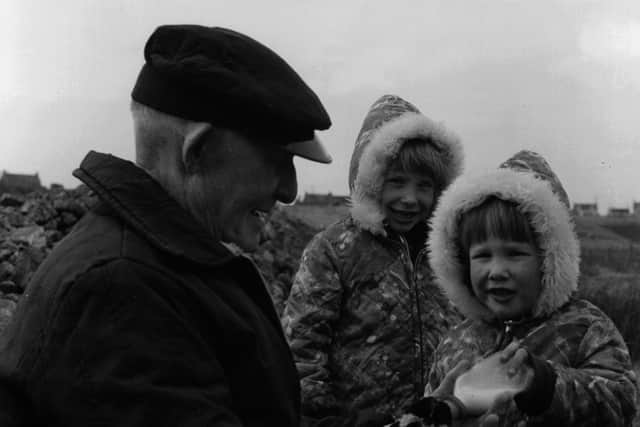
Marion recalls that her early summers were spent at 55 Lower Bayble and a picture in the book published by Acair in 1998 shows her with her grandfather on the family croft. However, all that came to a temporary end when she was aged seven and her father was seconded to Hawaii to work on the UKIRT project – to build and operate the second largest infrared telescope in the world.
“We might have stayed in Hawaii”, Marion recalls, “but circumstances in Lewis had changed”. Her grandfather, Red, had died in 1977 and her uncle Kenny was unwell. All of this contributed to a decision to return to Scotland where the family again settled in Edinburgh.
Her mother, under the name Catherine Maclachlan, wrote a book called “The Metagama Inheritance” based on her father’s experiences. She too was a witty writer who contributed for many years to the Rudhach and was also a frequent Gaelic broadcaster.
Catriona Dunn says: “During his lifetime, the village of Bayble was proud of having such a talented poet as Red in our midst, and his memory has been kept alive, through the stories his daughter Katie Ann contributed to the Rudhach, through the continuing popularity of his songs, and through the fact that his work is available in the book Òrain Red. His grand-daughter will now be celebrated for having contributed so significantly to the decision of the Supreme Court”.
WHEN MARION first went on the website Mumsnet, it wasn’t because she was worried about gender activism. Mumsnet describes itself as “the UK’s most popular website for parenting” and is certainly one of the more benign corners of the internet. She was simply the mother of a son then in his teens.
Marion recalls: “I just wanted tips about how to maximise the points on my Boots Advantage card, because Christmas was coming up.” However, she also read about “all the bonkers things happening in Canada”, which was starting to pursue a policy of gender self-ID, meaning a man could claim to be a woman, even without having undergone any medical treatment.
“And I thought, ‘Well, that can’t be right,”, Marion recalled in an interview with Holyrood magazine last year … “little thinking that her own government would, in 2022, pass a similar Bill, championed by Nicola Sturgeon.” (It was blocked the following year by Rishi Sunak’s government, and the Bill sank, along with Sturgeon’s career.)”.
By 2018, Mumsnet had brought her into contact with two other women, Susan Smith from Edinburgh and Trina Budge from Caithness, who were of the same mind. None of them had hitherto met each other. When I spoke to Marion last week, her time was in high media demand so I took the short-cut of confirming the accuracy of the Holyrood magazine interview, which I will now quote from.
“So FWS became Smith, Calder and Budge, none of whom had any experience of campaigning. The most activism Calder had done was to convince her son’s school to move its PTA meetings from the schoolrooms to the pub.
“In 2018 the Scottish Parliament passed a Bill that said the governing bodies of public boards had to be ‘gender balanced’. But Budge realised that because the Scottish Government insisted that men can identify as women, the boards could be all male and still be classified as ‘gender balanced”. (“Trina is so brilliant at spotting things. She’s a farmer but she easily could be a lawyer,” says Smith)”.
That improbable, though theoretically possible, scenario became the launch-pad for their campaigning and with it, as Holyrood pressed ahead with its Gender Reform legislation, a growing movement of opposition across Scotland. As the issue gained a higher political profile, women found their voices to oppose legislation in which Ms Sturgeon invested so much political capital.
In January 2019, the three women started lobbying MSPs and held their first public event at a hotel in Edinburgh.
“We sold out completely, which was lovely, but the hotel received threats from activists,” says Marion. “The hotel, to their credit, didn’t cancel us, but they said we needed to pay for eight security guards, not just two.
“But because Eventbrite wouldn’t release the money we made from ticket sales until after the event, we had to pay for the security guards on our credit cards”.
For Women Scotland describes itself as “a grassroots women’s group founded amid growing unease about how women’s rights would be affected by the Scottish Government’s plans to reform the Gender Recognition Act to allow for self-declaration of sex”.
Their argument with the Scottish Government boiled down to whether the Equality Act 2010, a piece of UK-wide legislation, meant that a trans woman — i.e a biological male — with a Gender Recognition Certificate is the same as a female. The Scottish Government said it did while For Women Scotland disagreed.
So too did the then Secretary of State for Scotland, Alister Jack, who refused to ratify the Holyrood legislation, creating a legal stand-off which it was ultimately for the Supreme Court to resolve. When the women decided to pursue their case to the Supreme Court, they crowd-sourced donations to fund their challenge at which point the writer, J.K Rowling, contributed £70,000.
The rest, as they say, is history which culminated in last week’s Supreme Court verdict though it is unlikely that the debate will end there. The current First Minister, John Swinney, has said they will “respect” the Supreme Court ruling while declining to apologise for legislation which led to the legal stand-off in the first place.
Marion, in the aftermath of the decision, stressed that they had not “changed the law”, as some reports suggested but had merely clarified what the Equality Act had intended to achieve. In contrast, the Scottish Government had attempted to make it mean something quite different.
The full implications of the Supreme Court ruling will continue to unfold but it is unlikely the work of For Women Scotland is done. As their mission statement makes clear: “We also challenge the ongoing push from Government-funded lobby groups to overwrite sex-based rights in legislation and public policy with the undefined and unscientific concept of gender identity.
“We work to highlight the devastating impact such policies have already had on the lives of ordinary women and girls in Scotland – in hospitals, schools, prisons, sports, public spaces and especially in women’s sector organisations such as Rape Crisis or Women’s Aid.
“Our work is informed by the experiences of frontline workers in these services and by the women and girls they provide for”.
Important though it is, the Supreme Court ruling is unlikely to have provided the last word on any of these issues. Meanwhile, those who are now piling on the abuse should not under-estimate the “determination, perseverance and resilience” in the Lewis genes!