
Anger as new ferry fund leaves the islands short-changed
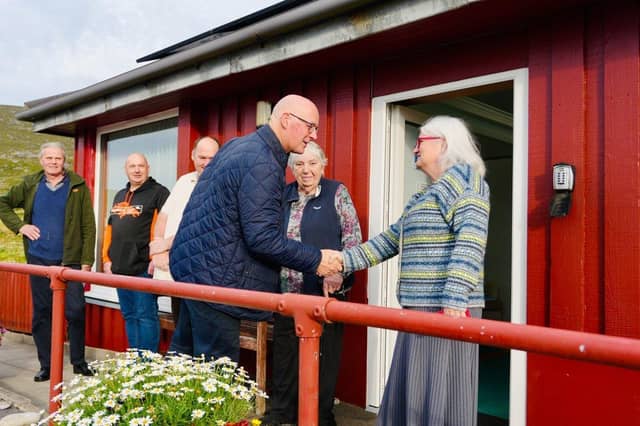

Scottish Government First Minister John Swinney has been accused of short-changing the islands, after it emerged that a ferry compensation scheme – announced as a pre-election promise – will deliver less for 2026-2027 than was available last year.
A press release in advance of Mr Swinney’s visit to the Western Isles for official and party engagements was greeted with surprise and disappointment. The £3 million “first phase” will be spread across the west coast islands, with only Lewis excluded.
Mr Swinney’s pre-election pledge of a £10 million Islands Resilience Fund came off the back of a disastrous Easter period for island businesses which the chief executive of CalMac described as the worst in the company’s history, with ten ferries out of action. There was no mention of the fund being “phased”.
Now, however, the £3 million announced is actually less than the £4.4 million last year while the only reference to the missing £7 million in the Scottish Government press release was that “further phases will be delivered over the lifetime of this Parliament” – i.e. five years..
The announcement ensured that Mr Swinney faced an uncomfortable reception, both from political opponents and business groups which were already pretty cynical in the light of experience with trying to access the previous Resilience Fund.
Asked by the Gazette why only £3 million will be available this year, less than for 2025-2026, Mr Swinney responded: “The whole purpose of the £10 million is to provide a combination of measures to address the disruption of earlier this year and to provide greater resilience for future years. It’s designed to address the challenges that were without doubt felt in the spring but also put in place greater resilience in the years to come.”
With regard to the remaining £7 million promised, Mr Swinney said: “The purpose of the fund is to make sure we can support businesses who faced difficulties and provide resilience for years to come. The learning from the scheme we put in place before will make sure we’ve got adequate provision in place to deal with the situation we faced this year which, of course, has got significantly better”.
The scheme, administered through Highlands and Islands Enterprise, will open for applications on Monday.
While the situation is certainly better than it was at Easter, there are ongoing breakdowns and disruption across the network, notably on the Sound of Harris crossing where the MV Loch Portain has now been out of action for a month, with no sign of an early return.
Businesses in North Uist, Berneray and South Harris continue to suffer massive losses of trade during the peak holiday season. While the MV Glen Sannox has been acting as a relief vessel between Lochmaddy and Tarbert, it is due to depart on Monday to allow “essential works” to be carried out on the quarter billion pound ferry.
Across the CalMac network as we went to press, 13 out of 30 CalMac routes were subject to disruption.
John Daniuel Peteranna, of South Uist Business Impact Group, said: “Anything that comes to island businesses to alleviate the problems caused by the ferry service is positive. But the level of funding we received last time was ridiculous.”
He said it was “shared with anyone who had a ferry” leaving Uist, the hardest hit community in terms of disruption, receiving little. “If it’s administered in the same way this time it will do nothing,” he said, “and this was the first we had heard about phasing.
“We as a business had losses of £30,000 but we qualified last time for only £3,000 compensation” despite “having spent weeks going over all the detail and ticking all the required boxes”.
Sarah Maclean, chief executive of Outer Hebrides Tourism, said the “phasing” with only £3 million available for 2026-27 had come as a “surprise” while she was also “disappointed” that businesses on Lewis are excluded.
She said: “As a destination marketing organisation, we have spent time explaining to Government that the interconnected nature of our sector sees visitors travelling through the islands to maximise their experience, meaning a ferry disruption at one end can have a knock-on for bookings right through the islands.
“We know businesses in every affected island lost thousands in revenue during periods of disruption and it is disheartening that some are still excluded”.
MP Torcuil Crichton said the islands had been “sold short” from the pre-election promise with “less than a third of the promised funds for beleaguered island businesses” on offer.
He said: “Across the Western Isles, in Uist and Barra and in Harris and Lewis, business losses have been mounting up. We have seen visitor numbers drop by thousands and business takings crash by as much as 70 per cent when the ferries don’t run to the mainland or between islands”.
The MP called for the Resilience Fund to be paid in full this year and for businesses like bakers, food suppliers and contractors in Lewis, which have also been affected, to be eligible for support.
Mr Crichton said: “Even for those who can meet strict eligibility criteria, these funds don’t touch the sides of losses. For many others business who have paid the financial and reputational cost of continued disruption, there has been no help at all”.