
TV series that lifts lid on island crime
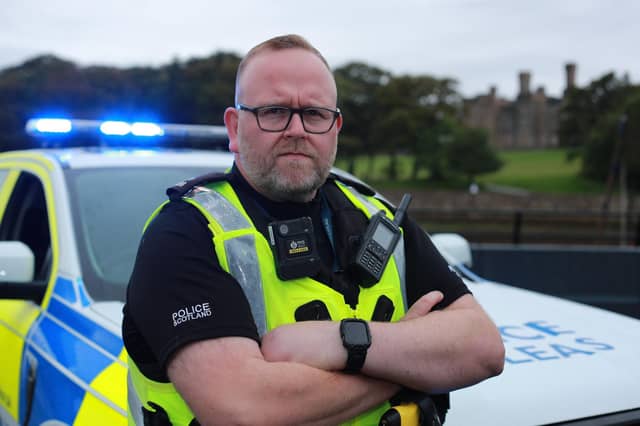

The future of the popular television series “Highland Cops” looks assured despite the impending closure of the outlet which first hosted it, the confusingly-named BBC Scotland channel.
“Highland Cops”, which is made by the independent production company Firecrest, has emerged as one of the success stories from the channel and has lifted the lid on the evolving nature of crime in the Highlands and Islands, as well as the varied nature of police work.
Now showing its fourth series, “Highland Cops” has followed a range of stories in the Western Isles, including several which have highlighted the extent of the illegal drugs trade – probably the major growth area in crime since the series began.
With the BBC Scotland channel due to close early in the New Year, producer Lewis Dodds told the Gazette: “At the moment, it remains to be seen what will happen. We have another series in the works, due to go out in autumn next year.
“The programme goes out on BBC2 and is also available on BBC i-Player, so there are other outlets. In fact, the current series is already available on i-Player from 6 a.m. on the day it is shown on the BBC Scotland channel”.
“Highland Cops” has the distinction of drawing the largest audience of any programme this year on the ill-fated channel, with around 150,000 viewers for the first of the current series. The bulk of its audience comes from UK-wide exposure on BBC2 where it regularly draws viewing figures of between 750,000 and 900,000.
Lewis said: “Obviously it is disappointing that the channel is closing but in one way, it could turn out to be a positive for independent production companies in Scotland.
“There used to be slots that Scotland got to utilise UK-wide channels and that changed a bit when the BBC Scotland channel was created. So maybe there will again be more opportunities for that”.
Lewis has been working on “Highland Cops” since 2021 and has seen a change in the nature of stories to emerge during that time. “You still get the nice Highland stories you wouldn’t see elsewhere in the UK but you now have more of the dark stuff as well”.
An example of this was an unprovoked machete attack in Inverness shown in the most recent episode which produced horrific footage and resulted in an eleven and a half year jail sentence for the perpetrator.
The next episode will feature a shoplifting story from Stornoway – or “retail theft” as it is now more accurately described. Lewis says: “It involves quite a high value theft from a local hardware store. The police locally were keen for us to utilise it because this is something they are having to deal with more and more.
“It’s well publicised that shoplifting is a big problem elsewhere but they have only recently started to see it as a serious issue in more rural places, including the islands”.
The series also promises “a really impactful story” from the Western Isles in two weeks time involving mental health issues and how the local police have to deal with them in the islands where there are fewer support services.
Lewis says: “Again, it’s something they are seeing a lot more of … people who have moved up or maybe come to escape something and then find island life difficult to handle”.
Over the past few years, the emergence of large-scale, drugs-related crime in the Highlands and Islands has been possibly the biggest revelation which “Highlands Cops” has shed light on. Inverness has been identified by drug gangs operating throughout the UK as a significant centre for distribution within the region.
“It’s quite alarming”, says Lewis. “and it has brought with it a lot of other issues, violence and so on. Drugs are coming through Inverness and heading to all sorts of other places as well. Local people are being drawn in, which is sad”.
“Highland Cops” has helped to raise awareness of these realities – and also of the chances of being caught by increasingly sophisticated policing.
For Lewis, the opportunity to explore island issues and social trends through “Highland Cops” has been a bonus as he has family connections with Lewis and Harris, creating a lifelong “passion for the islands”. His grandmother was a Maclean from Northton who moved to Gourock, where Lewis still lives.
He attributes the success of “Highland Cops” to the varied and distinctive nature of the cases they are involved in throughout the Highlands and Islands – “there is a decent level of crime but also a uniqueness” – and to a close relationship with the police built up over a decade of Firecrest’s wider programme-making.
The idea of the series came from the production company which also makes programmes like “Paramedics on Scene” and “Murder Trial” which tracks the history of complex, high-profile cases from start to finish – most recently “Death of a Dog Walker” in Perthshire. They saw “a gap in the market’ for real life portrayal of routine, but fascinating, police work which is rarely seen or understood by the public.
The failure of the BBC Scotland channel to attract larger audiences, leading to its closure, is seen by many as a lost opportunity. But it has produced some programmes of value – and none more so than “Highland Cops”.