
From Point Street to the Antarctic – a story deserving of recognition
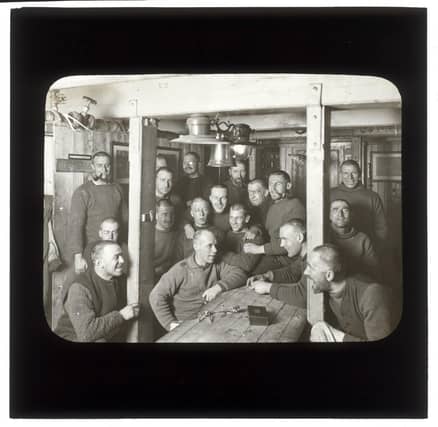

Surprisingly, the remarkable story of Thomas F Macleod’s Antarctic adventures are little known to the wider public and even many in the town of his birth Stornoway.
Thomas rose from humble beginnings to become one of a select group of less than two dozen intrepid souls to be awarded two Polar medals.
His name sits proudly among the country's most renowned polar explorers. Now 65 years after his passing there are plans in his hometown to commemorate Macleod’s achievements.
But just how did this cove from Point Street in Stornoway become a twice decorated veteran polar explorer and a trusted member of both Captain Robert Falcon Scott and Ernest Shackleton' s polar expeditions?
The story begins in Glasgow in 1873. Thomas’s mother Barbara Macleod, like so many other young island women, had travelled south to Glasgow seeking employment in domestic service.
The 1871 census tells us she worked at Gartscube House in Maryhill. In 1873 Barbera gave birth to a son, Thomas, at 11 Oxford Street in Tradeston on the south bank of the River Clyde. There was no father’s name recorded on the birth certificate.
As a young single mother in the late 19th century, Barbara’s options were limited, given the stigma and shame of her situation would have bestowed upon her by an unforgiving Victorian society characterised by class disparities. Infant Thomas was sent home to Stornoway where he was raised by his widowed grandmother.
They lived in modest lodgings at the end of Point Street less than 100 metres from the quayside.
Captain Alasdair Smith, the recently retired harbourmaster in Stornoway, has researched Thomas’s incredible life story.
“At the time Stornoway was a very major fishing port full of fishing luggers and trading smacks carrying herring as far as the Baltics. The harbour was his playground; he grew up around boats and ships,” he said.
Surrounded by maritime activity and having grown up breathing in the salty air, Thomas was consumed with a desire to venture beyond the next horizon – he was destined for a seafaring life.
This was typical of so many islanders. But what followed for Thomas was anything but.
“He shipped out of Glasgow when he was 13,” Alasdair explained. “His first voyage was on a square rigger bound for Australia. This was a classic square rigger voyage going through Cape Horn and returning through the Cape of Good Hope, a real sea going voyage.
"That’s what established him and that’s what he kept on doing, working as an able seaman on the square riggers although the square riggers were coming to the end of their era.
"But there were plenty still doing long-haul trade to places like Australia, Peru and Chile and he was what’s known as a shellback, an old salt-able seaman. On these square riggers it was a young man’s game climbing the masts tending to the sails in all weathers.”
By 1910 Thomas had amassed over twenty years sailing experience, including numerous voyages to every corner of the globe and serving with distinction in the Boer War.
At the age of 37 Thomas found himself in New Zealand unemployed and looking for his next berth.
His next voyage set him on course for three Antartica adventures and a role in perhaps the greatest story of survival against incalculable odds.
Thomas and fellow Leòdhsach John Graham of Ness boarded the yacht Terra Nova in Lyttleton Harbour after hearing Captain Robert Falcon Scott had a vacancy for an able seaman on his mission to reach the South Pole before his Norwegian rival Amundsen.
There was only one vacancy and Thomas the townie prevailed over John the Niseach.
So began the first of three Antarctic adventures and Thomas gained the status of the first Lewisman in the Antarctic.
His duties on the Terra Nova were to resupply Scott’s team annually and undertake oceanographic survey work. On the 18th of January, The Terra Nova returned to the ice with supplies for Scott’s team to be met with the news that they had perished in the snow.
Thomas and the Terra Nova returned to London in 1913 and in 1914 he was successful in joining Ernest Shackleton’s imperial trans Antarctic expedition and expedition. Its aim: to achieve the last remaining goal in Antarctic exploration – to cross the continent via the south pole.
What happened next is one of the greatest examples of survival against the odds by the crew of the aptly named “Endurance”.
Alasdair picks up the story: “The ice conditions vary from year to year and that year the conditions were far more severe than they had hoped and expected.
"The Endurance and her crew found themselves beset by the slowly drifting ice; the pressure of the ice was too much for the stern of the endurance to bear and gave way. The boat sank and they were forced to set up camp on the ice.”
When the ice began to break, they realised that their only chance was to try to reach Elephant Island and on to South Georgia. In order to survive the arduous journey sacrifices had to be made.
“They were only allowed to bring 2lb of personal effects on the journey,” said Alasdair. “Shackleton led by example discarding gold sovereigns and a gold cigarette case. Every ounce of weight was carefully counted and they needed to take as much food and supplies as they could carry.
“The ship's bible, a gift from the monarch, was to be left behind with only the inscription by the king and some of psalm 23 and a chapter from the book of Job taken with them.
“Macleod could not bear to see the bible discarded and took it with him on the desperate dash to Elephant Island.
“Shackleton made it to South Georgia and after weeks on Elephant Island. Thomas and the rest of the expedition were rescued by the steamer Yalta and taken to southern Chile after over 20 months stranded on floating ice and a barren, bleak Elephant Island which offered next to nothing in terms of sustenance. MacLeod had now lost around half his body weight, weighing around 100lb.”
Macleod was taken to Punto Aranas, in southern Chile, where he was given refuge to recuperate by an emigrant Scottish family named MacLean.
Upon leaving, Thomas gifted the MacLean family the bible adding a new inscription of his own. It now has pride of place on display at the Royal Geographic Society.
Fully recovered and ready for his next voyage, Macleod returned to the UK and served the remainder of the First World War on minesweepers.
Shackleton, meanwhile, was undeterred by his travails on the previous mission and embarked on his third expedition. He assembled a crew of which Thomas Macleod again was a key member.
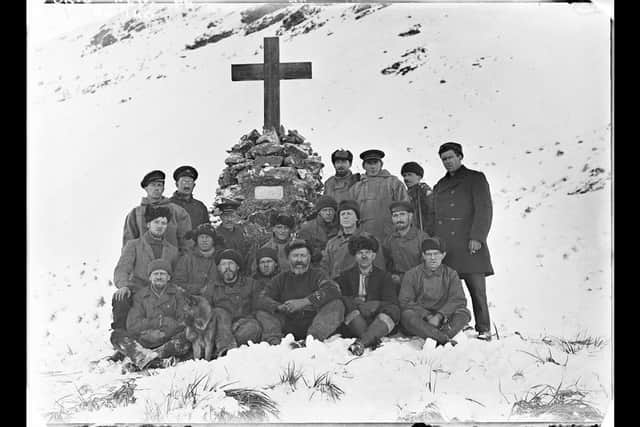
The hardships that he had suffered on the previous expedition had a profound effect on Shackleton’s health and he suffered a heart attack aboard the “Quest” on the journey to Antarctica. Macleod suggested building a memorial which stands to this day in South Georgia
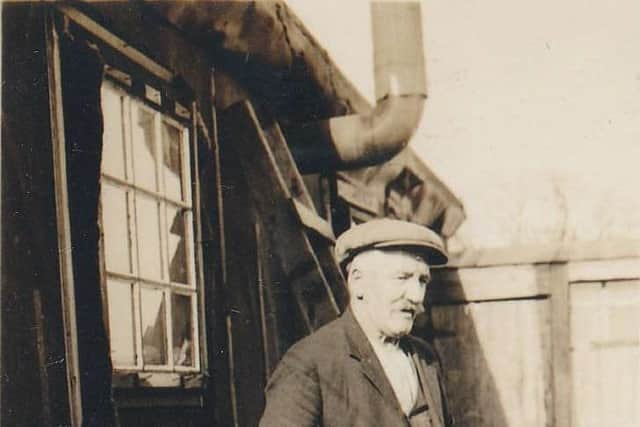
“When you look at the photo he looks exactly what he was: a no-nonsense hard-bitten sailor in the prime of life,” said Alasdair.
Macleod returned to London where he received his second polar medal, making him part of a select group of less than a dozen explorers that have been awarded more than one polar medal. His name sits deservedly in the esteemed company of Shackleton, Scott and Crean.
In 1920, encouraged by the geologist on the Quest expedition, Thomas emigrated to Canada to start a new life.
He was a fisherman in St Lawrence for a couple of years and finally became caretaker of a small school.
Alasdair describes Thomas’s life in Canada: “He lived in a small shack in contented poverty. His modest income supported himself and his two dogs.
“He rose at 4am every day to walk several miles in the dead of winter to light the fire in the school before the children began their lessons. He drew his water from the St Lawrence river and thought nothing of walking barefoot on the ice in the frozen Canadian winter
“He never gave up the idea of returning to the Antarctic and he actually applied to join an expedition but was told that all the places had been filled but that he would have been a welcome addition to the team.”
He spent the last years of his life in a retirement home but spent weekends with a local family and enjoyed nothing more than watching the boxing on television. He passed away in December 1960 but never gave up hope of one day returning to the Antarctic.
Alasdair remarked: “I think it's worth mentioning that there is a lot of Scotland’s history in the Arctic and Antarctic that isn’t well known. Dundee, Leith and Stromness were a huge part of it and Thomas Macleod from Stornoway was a big part of it as well.
“He had that adventurous exploring spirit. He wanted to see what was over the horizon and what was round the corner. He was hard bitten in many ways. He had a tough start. He was brought up by his grandmother here.
“There were a few opportunities in fishing, but he had that adventurous streak to see what is beyond the next horizon and when you have that in you wouldn’t settle for anything less”
Currently, and perhaps somewhat surprisingly, the only memorial to Thomas in his home town of Stornoway is a plaque on the building which now stands on the site of Thomas’s childhood home.
However, Stornoway Historical Society have plans for a commemoration of Thomas in a more prominent location in the town.
They are seeking funding to place a representation of Thomas on the wall of the town hall alongside Colin Mackenzie, surveyor of India, and Alexander Mackenzie, the Canadian pioneer.
Despite the lack of recognition in the town of his birth, Thomas’s name is remembered as far south as South Georgia, where his cairn to Shackleton stands to this day, and slightly closer to home in Lewisham, where three blocks of flats built on land once owned by the Shackleton family are named after stalwarts of the “Endurance” expedition: Macklin House, Woolsley House and Macleod House