
PSOs should be “strategic tools of inclusion”
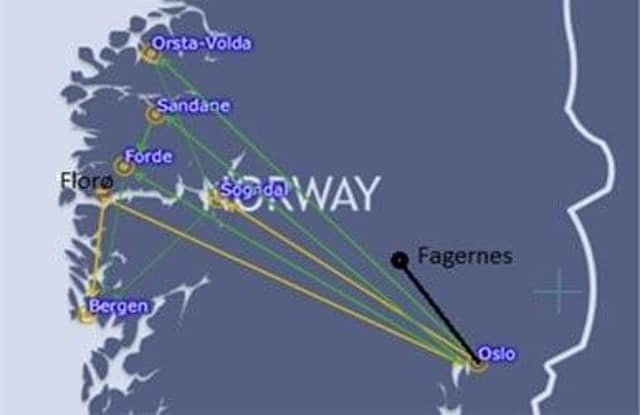

As controversy mounts over fares charged by Loganair, the Highlands and Islands Transport partnership, HITRANS, has produced a report on how public subsidy operates in two other countries – Norway and Greece.
Both make widespread use of Public Service Obligations which give governments and local communities far stronger roles in controlling fares and shaping services.
Sharp escalations in Loganair fares, particularly for non-residents but also islanders who benefit from the Air Discount Scheme, have led to calls for a Holyrood committee to examine the issue in detail – with PSOs one of the options available.
The HITRANS report states: “Across Europe, PSOs allow governments to guarantee connectivity where market forces alone cannot sustain regular or affordable air services.
“By defining clear service obligations and transparent compensation, they safeguard access to health care, education and employment, supporting both social inclusion and economic vitality”.
This approach in Norway is underpinned by a longstanding commitment to sustaining population in peripheral areas – a “national cohesion policy” which does not exist in Scotland.
The report states: “Norway operates a centrally funded national PSO network embedded in its national cohesion policy… Over three decades it has delivered reliable connectivity, equitable fares and pioneering work toward zero-emission regional aviation.
“Norway treats air services as a public utility, a permanent component of its regional development and social cohesion policy. The PSO system ensures that residents of even the most isolated communities enjoy the same level of connectivity as those in major cities.
“This principle is central to Norway’s longstanding regional policy designed to sustain population and opportunity throughout the country.”
Each PSO route is subject to a maximum fare. As of 2024, the fare ceiling averages £100 one way with additional discounts for residents.
On Greece, the report states: “Greece manages a PSO network linking the mainland with over 200 inhabited islands. Its routes are jointly funded by the Greek Government and the EU, sustaining affordable access for hundreds of thousands of island residents.”
The report continues: “For Scotland, these cases demonstrate that PSOs are strategic tools of inclusion, not short-term subsidies. A unified framework would deliver affordability, environmental progress and national equity”.
Instead, the report says, “support has evolved piecemeal through a combination of Scottish Government PSOs, local authority networks and the Air Discount Scheme, producing uneven fares and service quality.
“Roughly £27.8 million per year of public funding already sustains Scotland’s lifeline air services. Redirecting this existing spend into a unified framework would enhance efficiency and transparency without materially increasing total cost”.
While domestic transport is devolved to the Scottish Government, the report suggests that a contribution from the UK government would “allow the ambition of strengthening Highlands and Islands connectivity to major Scottish centres and UK regional centres including Birmingham, Manchester, Newcastle, LeedsBradford and Southampton to be included within the PSO network”.