
Transocean grounding – a reminder of the sea’s potency
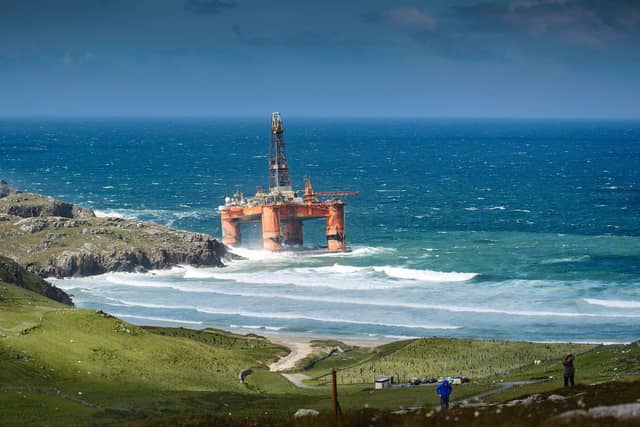

When the phone rang at 6.45am on 8th August 2016, it was the beginning of a news story, with international connections, that would run for the next two months.
A fishing industry contact had spotted a developing maritime crisis in the storm off the west coast of Lewis. An oil rig had come ashore on Dalmore beach.
A screen-grab from the AIS ship-tracking app showed the back and fore, zig-zag path of the stricken rig and the tug which had it under tow. The track went between the Flannan Isles and St Kilda and back again and then towards the west of Lewis, ending near one of the most beautiful beaches in the island.
An hour later, I could see the 17,000 tonne oil rig Transocean Winner sitting askew on Rubha an Trìleachain, a tidal reef on the left-hand side of the horseshoe-shaped Dalmore Bay. From the shore it was impossible to see what damage it had sustained, but it was stuck fast on the rocks. The rig was being towed from Stavanger to Malta, to be sold or scrapped, when the Atlantic weather intervened.
Further out to sea the forlorn tug, ALP Forward, stood off, beaten by the weather and a rig that had come back from the dead, determined to insert its own thread into the Western Isles’ rich tapestry of maritime history.
The smell of diesel ebbed and flowed with the crashing waves and strong gusts. The storm had been forecast for four days and had proved too strong for the tow line and the ALP Forward’s pulling power. In the foreground lay Dalmore cemetery, the resting place of many who knew the moods of the sea. That morning the sight seemed to symbolise the fate of the now apparently wrecked leviathan.
The rig was built on two pontoons which would normally be submerged well below the surface of the sea. One pontoon was now partially visible as were the two horizontal steel tubular bracings between the rig’s legs. The first concern was the potential for pollution from ruptured fuel tanks in the starboard pontoon which leaked 53,000 litres of diesel into the sea. Evaporation and wave action dispersed the diesel and prevented this from happening. Soon the big players, who were to have such a significant influence on the rig’s fate over the next 10 weeks, began to arrive.
Foremost among these was Hugh Shaw MBE, the UK Government’s Secretary of State’s Representative (SOSREP), who was in overall charge of the salvage effort. His powers were extensive.
While the incident was ongoing, these powers allowed him to call in any resources he deemed necessary and also gave him the final say on any proposed course of action. He was answerable to the Secretary of State, but only after the incident was resolved.
He was excellent at keeping the media and the local community informed and at handling public meetings and awkward issues as they arose. He lived in Fife, when he wasn’t sorting out maritime crises, and seemed totally at home dealing with oil industry representatives, salvage experts and local people, councillors and politicians.
It was instructive too, to watch the performance of some mainland-based journalists, who were flown in, with the story they wanted to tell already fixed in their minds. They had little concern about their actions because, not being part of the community, they were unlikely to come across any of the people with whom they dealt ever again.
After the first couple of days, it was obvious that there was no danger of pollution from the rig. The company made clear they were going to remove the rig and any debris that would be left behind. They promised to monitor the seabed for some time afterwards to ensure that no new debris appeared. They were also open to discussion about some form of compensation for the disruption the grounding of the rig had caused.
The company and SOSREP wanted local businesses, including boat owners, accommodation providers, a drone operator and engineering firms, to help them prepare for the salvage operation. Yet the visiting journalists were determined to find people who were disgruntled, which they managed to do, at the cost of damaging these people’s credibility within their own community.
An exclusion zone had been imposed around Dalmore beach, with limited access allowed for the media to do their live reports for radio and television. They advised everyone else to keep off the beach until the rig was removed. One sunny afternoon, while we waited for our programme deadline, we noticed two young women, wearing backpacks, coming over the hill on the south side of the beach, from the Garenin direction. They headed for the beach and went for a paddle. My colleague went down to tell them that the area was restricted. When the two, who were from the continent, asked why, he pointed to the rig. “Oh,” they said, “we thought someone had just left it there, like the old cars.”
Another of the main players was Sylvia Tervoort, salvage master with SMIT Salvage, who, from the outset, was confident the rig could be refloated. She had taken part in numerous salvage operations before that and once the rig was sorted, she was away to another job on the far side of the world.
Before she left Lewis, she was invited to address students in the Lews Castle College of UHI to encourage them to think beyond the traditional paths when making their career choices.
Preparations for a refloat were made which appeared to consist of lifting a large number of generators, air compressors and hoses aboard the rig, firing up as much of the rig’s own systems as were still operable and using the compressed air to keep the seawater out of the ruptured tanks to make the rig buoyant.
That also involved seemingly hundreds of steel flanges manufactured by Gordon Diesel in his workshop on Seaforth Road, which were laid out like a field of metal mushrooms, waiting to be transported to Dalmore.
Two weeks after the grounding, on 22nd August 2016, all was set for the refloat. People came from all over the island and joined the teams of workers who weren’t required aboard the rig or the tugs and a wide range of media, to witness the attempt.
It was a party atmosphere worthy of a famous regatta and picnics were organised on the grass just outside the exclusion zone above Dalmore beach as the evening light began to fade.
Just after 10pm, at the height of the tide, two powerful tugs pulled the rig out to sea and the precarious journey began to take the rig to a safe anchorage in Broad Bay.
There were moments, it was revealed later, when the long rollers coming in from the Atlantic, even although there was little wind, threatened to overwhelm the buoyancy of the rig which was badly holed. The tow proceeded slowly and the rig ended the short voyage the following morning. It anchored in Broad Bay and several tugs remained on standby throughout its stay.
A few days later, Transocean decided that trying to sell the rig was no longer an option and the rig was to be scrapped. The rig spent several weeks anchored in Broad Bay waiting for transport to the breaker’s yard. At night it was lit up, as if a small village had suddenly risen from the seabed, a halfway house between the red and blue sides of the Bay.
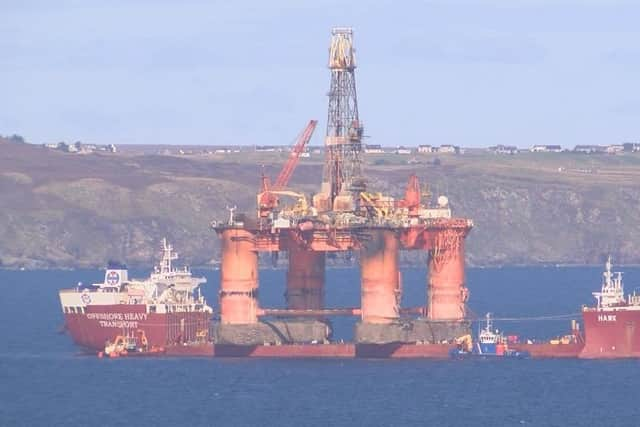
A heavy-lift ship, a converted tanker, the Hawk, was known to be between contracts and it was chartered to convey the Transocean Winner to Malta to remove some of the superstructure and then to take the rig to a decommissioning yard in Turkey.
The Hawk had a long section of its sides between the bow and the bridge at the stern removed and had a strengthened deck. With another contract for the Hawk pending, the operational window for transporting the rig was tight.
On October 7th, with a calm sea in Broad Bay, the lifting operation began. This took several hours and was awe-inspiring. The ship was ballasted so that it sank down in Broad Bay, until only the bow and stern superstructure was visible – deep enough for the rig to float free from its anchors and to be pulled across the ship’s deck.
It was held in position by the tugs while the ship was de-ballasted and floated up underneath the rig, gradually lifting it out of the sea. When the operation was completed, the two giants of the sea sat on the surface as one.
The weather on the day was mild and sunny and we were taken up beside the Hawk for close-ups of the rig and to see the holes in the rig’s pontoon. The sheer size of the two vessels dwarfed the large dinghy in which we had sailed out from Brevig pier and made it seem impossible that one could be piggy-backed onto the other.
Yet the jagged holes torn by the rocks of Dalmore in the rig’s pontoon showed just how vulnerable even gigantic structures can be and how quickly their huge size can be compromised by the sea.
There followed days of intense work by welders, platers and riggers securing the rig to the deck of the Hawk. Finally, on Friday 14th October 2016, the first Friday of that year’s Royal National Mod in Stornoway, the Hawk, with the Transocean Winner onboard, headed for Malta.
One lady from Flesherin said she was disappointed that it had gone. She had hoped, with all the lights shining from the rig at night, a brightness that cut through the worst of the weather, that it could have stayed until Christmas.
And that is the paradox of the rig. It could have been so very different. It could have had serious pollutants on board, it could have been an oil tanker, a chemical tanker, or even a vessel carrying some deadly waste that could have destroyed the west side of Lewis and the fishing grounds offshore.
Instead, it was a rig that was on the way to the scrapyard and that, given the history of the islands over the past 50 years, represented an industry that is well-known to the island people and that has become part of the lifeblood of the Islands’ economy.
The first rig in Lewis, the Drillmaster, anchored off Arnish in the late 70s, in the early years of oil exploration, marked a boom time for the Lewis economy. It was the means of teaching many the skills that have taken them to other rigs and oil fields throughout the world, while enabling them to continue to live in the Islands with their families.
The Transocean Winner brought a mini-boom of its own. Many service companies benefited from the rig’s short sojourn in the islands. It brought international media attention and showed the initiative and hospitality of the islands and islanders at their best.
Most islanders quickly accepted the personnel in charge, who were respectful of the island people and culture and ensured that island businesses gained from their unexpected visitor.
The initial suspicions of some of the people were tempered by the knowledge and experience of those who knew the oil industry and the sea and who knew that many of the fears were unfounded.
In addition to the gains to the wider local economy, Transocean donated £120,000 to the communities of Dalmore and Carloway, which were most affected by the rig’s arrival.
Dave Walls, Transocean’s operations director for north-west Europe, said: “I would like to thank the kind and generous people of Lewis for their support, hospitality and patience since the rig grounded at Dalmore.
“The response from the island has been both overwhelming and humbling and I hope the donations go some way to recognise and acknowledge the warmth and welcome extended to Transocean and our business partners.”
That is a commendation and a reputation that should be valued and protected.