
We need to know what’s going on out there...
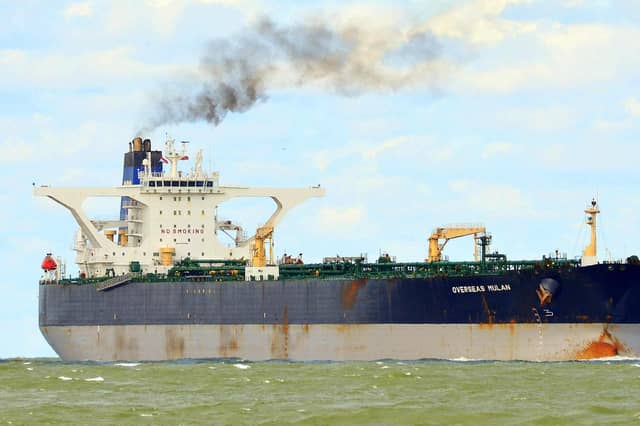

Driving into Mangersta the other day, I noticed a tanker on the horizon and, as I occasionally do, looked at the Vessel Finder app out of idle curiosity, to learn what was out there and where it was heading for. In light of all that has been going on around us, the information was quite startling.
That vessel I had observed is named the ‘Adonia’. It was en route from Port Said to an unnamed destination, probably Murmansk. It is part of the Russian “shadow fleet” which “continues to generate multi-billion revenues for the Kremlin by by-passing sanctions, using complex schemes to disguise owners”.
The ‘Adonia’ is sanctioned by the United States, the EU and, since last September, the UK. Yet there it was, within plain sight of my kitchen window. In theory at least, I suppose there was a case for the ‘Adonia’ to have been boarded and captured, according to the same principles which governed detention of the ‘Marinera’, by US Special Forces, not all that far away, a couple of days earlier.
In an increasingly chaotic world, the ‘Adonia’ symbolised just how various conflicts overlap, with starting points increasingly irrelevant. Pursuit of the ‘Marinera’ flowed from the American coup in Venezuela. Sanctions on the ‘Adonia’ resulted from Russia’s invasion of Ukraine. Yet here were both vessels in the North Atlantic, confirming its status as a potential front line in global rivalries.
Beyond even these factors is the grotesque spectacle of President Donald Trump threatening the annexation of Greenland which is territory owned by a NATO ally, Denmark. As climate change exposes limitless supplies of precious Arctic minerals, American commercial interests transcend loyalty to defence pacts with Europe. On multiple levels, both Russia and China seek to exploit this disunity for their own ends. The North Atlantic has become a theatre of uncertainty.
In a sense, the most blatant example of Russian presence in Hebridean waters was the least concerning. Last November, it was reported: “HMS Dragon monitored Russian intelligence- gathering ship ‘Yuri Ivanov’ as it loitered in waters off the Outer Hebrides following the completion of a major NATO exercise, Formidable Shield, that took place nearby. The Type 45 destroyer continued to watch and launched her Merlin helicopter to collect information from above, until the ‘Yuri Ivanov’ headed north towards its home in the Arctic”.
That sounded more like the old Cold War stuff, to which we became accustomed. The Russians watch NATO exercises and, I’ve no doubt, we watch theirs. That has been happening for decades and while it is sad that the shadows of these dark days of a divided Europe seem to be returning, it is the threat from more subtle forms of potential warfare that now demand reappraisal of how we respond to them.
Three days before Christmas, the Russian research ship, ‘Akademik N. Strakhov’, turned up less than 20 miles north of the Butt of Lewis. The obvious question is: “What was it researching?”. The vessel has been traversing the world’s oceans for 40 years and, for all we know, may be engaged exclusively in benign endeavours on behalf of the Institute of Oceanology of the Russian Academy of Sciences.

The less charitable theory is that it could have been taking a close interest in the location of underwater cables and offshore installations as part of a vast, ongoing intelligence-gathering exercise which might, at some point, facilitate future aggression against UK and other European sub-sea infrastructure. Or maybe, for cover, a bit of both?
“We are acutely aware of the threat posed by Russia”, says the Ministry of Defence, “which includes attempts to map undersea cables, networks and pipelines belonging to both the UK and our allies, and we are tackling these threats head on”.
There is no shortage of cables, networks and pipelines to map in our own part of the world. While we take for granted the wonders of a digital age in which vast quantities of information are transmitted at the press of a computer key, we have had little reason to reflect on the extent to which all this is dependent on seabed cables. There are hundreds and 97 per cent of data, we are told, flows through them.
Most of the transatlantic cables find landfall further south, as they have done since the first telegraphic communications in the 1850s. The shortest crossings from the east coast of America end up in Cornwall, or the west of Ireland. But the map also shows, for example, the Havfrue system which in 2020 was “the first new undersea cable traversing the North Atlantic to connect mainland Northern Europe to the US in nearly two decades, spanning 7851 km", via the north of Scotland with Google and Facebook among the investors.
Routes and landing points are not advertised, for understandable reasons, but nobody doubts they exist. The result is that we really know very little, and think less, about what is out there in the wild Atlantic – and which may well be of interest to a hostile force with long-term plans to do economic damage without a bullet being fired. That, it seems obvious, is a new form of warfare that needs to be safeguarded against. But how prepared are we?
A briefing by the security consultants KCS International describes the challenge succinctly: “What was once a forecast is now an undeniable reality. Russia’s hybrid operations have not only intensified but quadrupled in 2025, exploiting every weakness in a system that has been allowed to decay. Yet governments remain paralysed, unable or unwilling to respond with the speed and cohesion the situation demands. This paralysis is not confined to the UK; it is a Europe-wide failure”.
That summary continues: “Compounding this vulnerability is the ownership model itself. Over 80 per cent of our critical infrastructure is privately owned, designed to create short-term returns, not resilience. Accountability is fragmented across regulators, operators and governments, creating a patchwork of responsibility where strategic risk is routinely externalised - until the moment it is exploited.
“A stark example of this is our undersea cable exposure. Europe’s lifelines for data, communications and finance lie largely unprotected on the ocean floor – accessible to any actor with the capacity and intent to interfere. They are ideal targets: high-impact, low-visibility and easily deniable. A single disruption can ripple across economies, governments and societies.
“Russia has spent years – arguably decades - mapping these vulnerabilities with forensic precision. What we are witnessing now is not opportunism but the execution of a long-prepared strategy. The intent is clear: to inflict damage, sow uncertainty and weaken Europe’s ability to respond collectively”.
The most recent intelligence reveals that damage to cables has been reported off the Baltic countries while there have also been attempts to disrupt and destroy infrastructure around the North Sea. The Royal Navy and RAF are on round the clock patrols to forestall possible attempts to disrupt and, potentially, destroy.
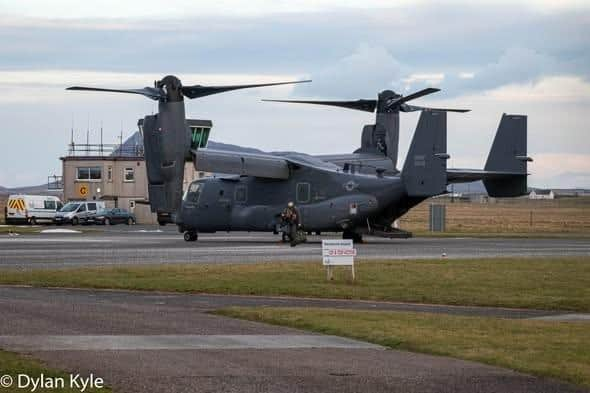
Apart from bringing the fall-out from global events closer to our kitchen windows, what does all this mean for the Western Isles? The answer may be hinted at by the intense activity which accompanied the operation to seize the ‘Marinera’ last week, which came within a few hundred miles of our coast. Suddenly, the strategic significance of Benbecula and Stornoway reasserted itself, as support bases for American operations in the North Atlantic.
In the new scheme of things, and with the Government’s commitment to greatly increased defence spending, it seems unlikely that arrangements for safeguarding the North Atlantic, or how the Outer Hebrides can be a more permanent and prominent part of that structure, will not have come in for fresh consideration,
Forty years ago, when there were plans for Stornoway to be turned into a very large NATO base, it was to protect “the Faroese gap” against incursions by the Soviet Union. At that time, the image of military threat was still formed along conventional lines, rather than in terms of shadowy vessels seeking to chart cables and pipelines with a view to subsequently breaching them, in order to bring society to a grinding halt.
And it certainly was not about the possibility – which last week turned into reality – of rogue vessels being apprehended in mid-ocean as part of a far wider global upheaval, encouraged by an American president who respects no international rules. The world has changed, dramatically, without most of us really noticing. Our position on the periphery of Europe and the North Atlantic makes us a far more strategic part of it than anyone would have wished for.
But maybe the threat is not even so long-term. I got a message at the weekend from a friend in the security industry: “Tracking of certain tankers and trawlers is very important and frequent”, he reported. In other words, we need to be more aware of what is going on out there and to recognise the implications, however uncomfortable.
To return to that KCS International briefing: “The question is no longer if the next attack will occur, but how severe it will be - and whether our governments will finally recognise that critical infrastructure protection, attribution and response are collective security obligations, not optional national add-ons or private-sector afterthoughts. Fragmentation is a gift to hostile actors. Unity is the only credible defence”.
The symptoms of potential conflict are a lot less tangible than in times past but that does not mean they can be ignored. If, through strategic positioning, the Western Isles have a part to play in our defences against new forms of vulnerability, then that is an option which should be recognised and considered through open eyes.