
A world-class facility inspiring a generation
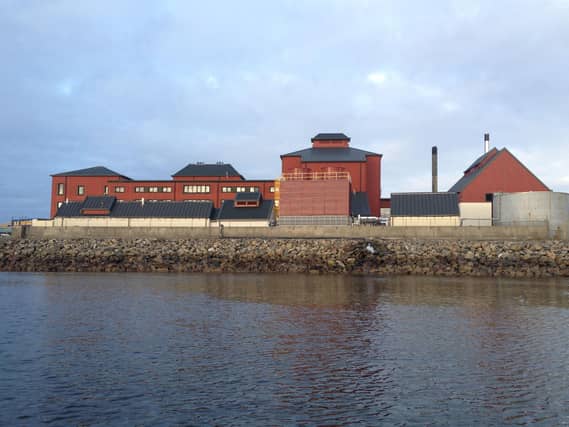

When it was announced during the summer that BASF in the UK had acquired a new managing director, Lisa Kelly, equal billing was given to the fact that she had taken over the same role in BASF Pharma (Callanish).
That might just be a corporate quirk but it also seemed like a nice bit of status to be awarded to the operation at Breasclete which has become one of the great Hebridean success stories, with a pedigree that has evolved over several decades.
The term “world-class” tends to be devalued by overuse but there seems to be absolutely no dispute that the science which happens at Breasclete is worthy of the description. Indeed, BASF – a global force in chemicals, including pharmaceuticals – would not be there without the skills that it inherited on the island.
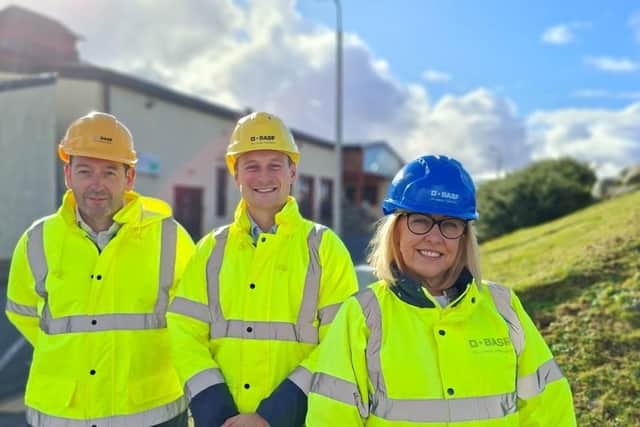
Lisa was in Lewis for the first time last week to see for herself what goes on and to provide a resounding vote of confidence. Her visit coincided with the 20th anniversary of the company which BASF took over, Equateq, itself being founded and also with an award which recognised the company' s excellent outreach work with island schools.
Having been suitably impressed both by the ultra-modern facility at Breasclete and the people she met there, Lisa said: “It’s hugely important to the group with a highly skilled workforce in a very niche market area.
“Not many employers are offering this calibre of work and the opportunities that go with it. The fact it is being done here makes it quite special both for the business and for the island”. Special indeed – possibly the best available example of how appropriate technology can bring high quality jobs to the islands.
There is also a wider lesson to be learned from the success of the Breasclete plant which involves the necessity of risk-taking in public investment. Back in the 1970s, the Highlands and Islands Development Board – which was at that time expected to take risks – invested in a fishing strategy for the Western Isles.
Construction of a factory at Breasclete was central to the plan, which did not work out as intended. That in itself is a long and winding story but when the original business, Lewis Stokfisk, went bust there was still a factory which needed to be put to use and the HIDB had a strong reputational interest in seeing it through.
Without that original investment, there would have been no factory and no employment – right down to the present day. In 1986, the HIDB found the pharma entrepreneur, Dr David Horrobin, to fill the gap that had been left by Lewis Stokfisk’s collapse.
His company, Callanish Ltd, was set up with four employees and gradually grew over the next 20 years, always with support from the HIDB/HIE. Dr Horrobin was quite a controversial figure in the medical world and also had his commercial ups and downs, with the company he had founded in Nova Scotia, Scotia Pharmaceuticals, eventually going bust.
However, the ultimate success of BASF (Callanish) tends to suggest that David Horrobin was pretty much right all along – since it is the work which he started there that has evolved over 40 years into the science practised at Breasclete which makes it one of the most advanced centres in the world for separation of Omega-3 fatty acids.
There are no longer fishing boats landing at the pier at Breasclete (though it is still used by fish farming businesses) and the fish oils used at the BASF plant have already been processed to a certain degree in another BASF site. They are then taken to the highest levels of purity before the products which emerge from Breasclete are shipped globally to pharmaceutical companies for use mainly in the treatment of cardiovascular disease.
The Breasclete site manager, Angus Morrison, has been integral to that journey. A native of Keose in Lochs, he studied at Glasgow University and had the opportunity to come back to the island in 1995, working as a research chemist with David Horrobin’s Scotia Pharmaceuticals Ltd.
Now, says Angus, about BASF (Callanish): “The business is thriving, with 67 employees, many of them graduates in science or engineering. It’s really good to see how the site has transformed, from quite humble beginnings 20 years ago.
“When Equateq formed in 2006, there were initially eight staff working on Omega 3 and Omega 6 research and development, as David Horrobin had been doing since the 1980s with Scotia Pharmaceuticals and Callanish Ltd.
“So there really has been a continuum. Today, we have a world-class, state of the art technology that has been created by BASF Callanish, in a world class facility, right here in the Western Isles”.
Are their downsides to being located on the west side of the Hebrides for a company serving a global market? In theory, the length of the supply chain could be problematic but BASF’s continued presence confirms that it is outweighed by the pluses. And, says Angus: “We get an excellent service from local haulage firms”.
Equateq was founded by Dr Horrobin’s son-in-law, Adam Kelliher, and the story of how BASF – a global conglomerate which employs more than 100,000 people – discovered Breasclete was told at the time of the takeover in 2012. It was a marriage made in heaven for both parties – Equateq needed investment to expand and BASF needed the expertise which existed at Breasclete.
At that time, BASF was aiming to become a major global player in the market for Omega-3 pharma and food ingredients. They needed a cutting-edge process which would give it a technological lead in the extraction from fish oil of high concentrations of the two key fatty acids.
At the opening of the enlarged Breasclete plant – by then branded as BASF Callanish - the then president of the company’s nutrition and health division, Walter Dissinger, said: "The first I knew of Equateq was when a colleague came into my office and told me we had found what we wanted.
"We had to move quickly. Here was a valuable pocket of knowledge which had been created over a minimum of 20 years, if not 30 years”. He described Equateq's process as “a global benchmark of lipid separation technology which is able to achieve a purity rate of 99 per cent”.
A board member of BASF, Michael Heinz, now retired, told the same press conference: "When I was told about the company I had to look up where the Isle of Lewis is because I had no idea. I had to be convinced and the rest of the board needed even more convincing. I now know we made the right decision.
“This technology - the most advanced in the world for separation of Omega -3 fatty acids - fits in very well with our objective of a sustainable future. We are here to stay”. And so, thankfully, it has proved to be.
For such an important business to the island economy, BASF (Callanish) maintains a generally low profile. Last week, however, it did a bit of beating its own drum with good justification, to recognise the success of its outreach programme for schools, ScienceXperience.
In the case of Lewis, the programme has the potential to complete a virtuous circle. If children can be encouraged to become interested in the technology that is being applied on their doorsteps, then maybe it will lead to more of them eventually using that route to find a way back to the island.
The programme has been bringing pupils from ten primaries into the BASF site, where they take part in practical experiments and meet employees who work in science, engineering, manufacturing and technology roles. ScienceXperience has reached more than 500 pupils, supported by 11 BASF employee volunteers.
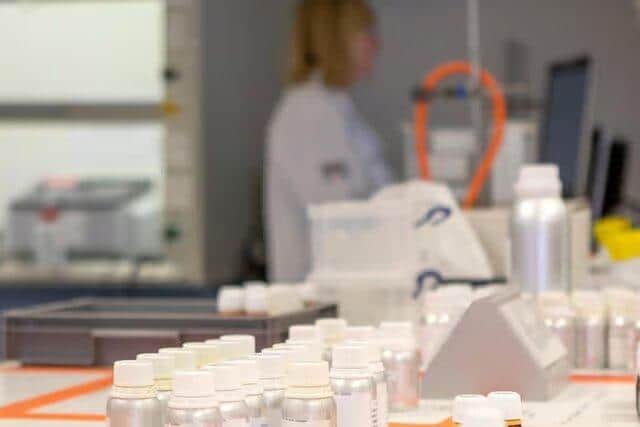
Karen Massey, technology and development manager at Breaclete and ScienceXperience team leader, describes the children’s response to their visits as “inspiring”. She says: “When the children go around the site, they are very excited and also surprised by the size of the factory. We ask them to draw pictures of what a scientist should look like, which is quite a revelation for the volunteers! They learn about the importance of Omega-3 and then we go into the labs, where you usually get all the gasps.
“By the end of the session, they have thoroughly enjoyed themselves and we ask them to raise their hands if they want to be scientists. Every one of them puts their hand up!”.
It was for ScienceXperience that BASF Callanish was recognised with the Community Impact Award (Large Organisation) at the Scottish Impact Award. The judges said: “BASF Pharma is recognised for the significant and lasting impact it delivers within its local community. The award recognises the organisation's commitment to education, skills development and supporting future opportunities in a remote area, demonstrating how business can create positive change beyond its core operations”.
Angus Morrison said: "We are incredibly proud to receive this award. As a major employer on Lewis, we believe we have a responsibility not only to manufacture products that improve lives around the world, but also to invest in the future of the community where we live and work”.
It all adds to the impression that the Breasclete success story is secure – and seems set to continue into another island generation. The future lies with these children who put their hands up being given realistic opportunities to stay or return.