
Sheep numbers down by a huge 48 per cent
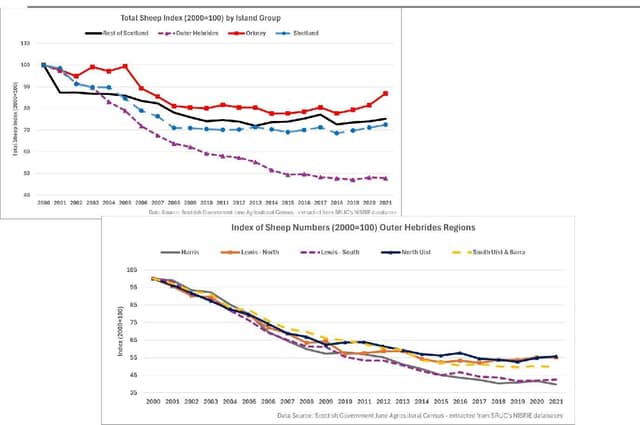

A recent in-depth report which highlights the importance of crofting and agriculture to island economies reveals the extent of the sector’s decline in the Western Isles in the last 20 years.
Unveiled last week, the report, which was completed months ago but was delayed by the Scottish Government for publication as the new Agriculture Bill was being finalised, outlines how current support schemes have actively worked against small producers and those facing the challenges that come with being based in the islands.
The research, which covered Orkney, Shetland and the Western Isles, was conducted by Scotland’s Rural College and led by Professor Steven Thomson, a highly respected figure on the challenges facing agriculture production in remote locations.
While the report underlines that the crofting sector still provides a vital economic contribution to the Western Isles, it makes for some stark reading, even in comparison to the other island regions.
The number of sheep has halved in the space of 20 years – down from nearly 300,000 on over over 3,000 holdings in 2000 to 143,000 on 2,200 holdings in 2021. In Orkney and Shetland the reduction is much less pronounced and Orkney actually fares better than the Scottish average and has actually seen an increase in recent years.
The report also details the regional variations within the Western Isles, with the biggest decline being seen in Harris, a reflection of the challenges and the lack of support for maintaining activity on the poorer quality land.
The report said: “In contrast to long term trends in Orkney and the rest of Scotland, there was a long term decline in the number of holdings carrying sheep in both Shetland and the Outer Hebrides over the 2000-2021 period. Outer Hebrides sheep numbers in 2021 (c.143k) were only 48% of what they were in 2000 (c.299k), compared to Shetland and Orkney where sheep numbers have been retained better (75% and 87% of the 2000 head count in 2021 respectively).”
The report also details the increased cost facing island producers compared to the mainland. Fertiliser costs are 22 per cent more expensive in Lewis and Harris (13 per cent more in Uist and Barra); red diesel 19 per cent higher (14 in Uist and Barra); animal feeds 29 per cent more (35 in Uist and Barra) and haulage costs around 200 per cent higher across the Western Isles.
That has clearly had an effect, as the report makes clear: “The cost of input supplies and moving finished product to market are considerably higher on the islands than on the Scottish mainland. This puts island producers at a competitive disadvantage from mainland producers.”
It added: “Over the last 20-years there was a general reduction in the number of supported croft and farm businesses, with some marked reductions in livestock numbers in some places, notably sheep decline in the Outer Hebrides. This reflects the interaction of local conditions with market pressures but also several key changes in support, demonstrating how policy affects land use.”